

Overview
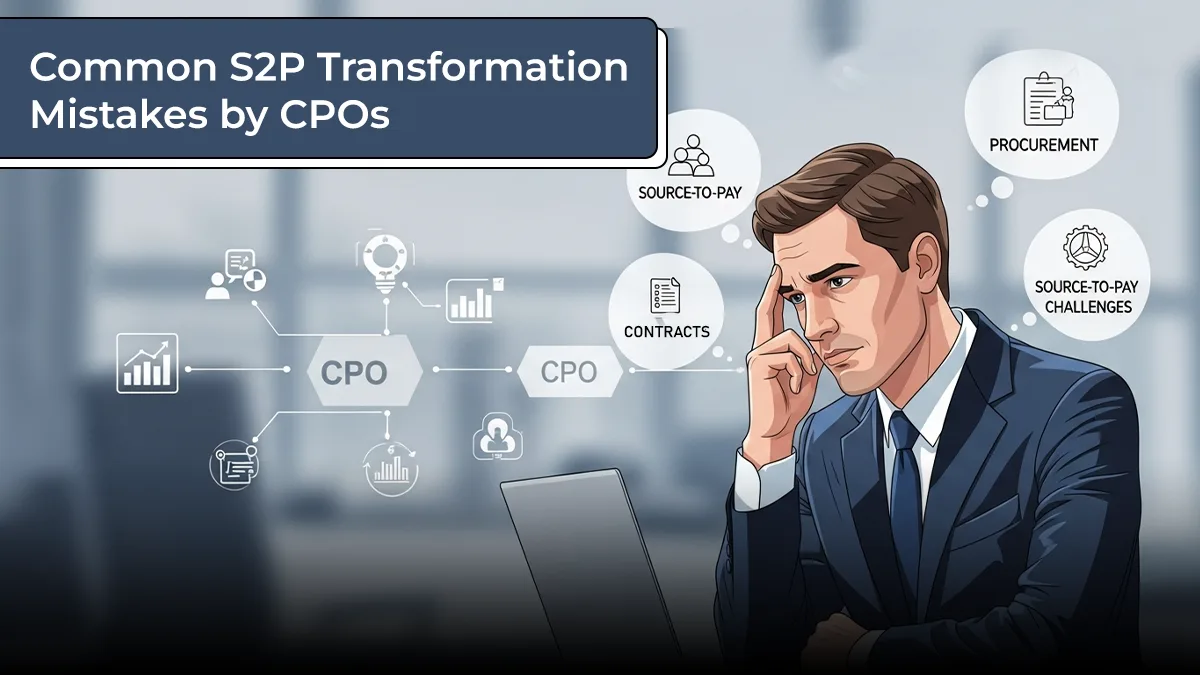
Let’s face it. Most S2P projects begin with some objectives. These ambitious objectives include more spending visibility, stronger compliance, faster sourcing cycles, and improved supplier collaboration. However, these projects require transformation over the period, and this change goes beyond just a technology change. Here, many Chief Procurement Officers (CPOs) make mistakes. Let’s explore some common mistakes in this post.
We will also dig deeper into the role of source to pay software in correcting these mistakes. This software can reshape the procurement process to create value. The s2p software can drive transformation. However, it is necessary to choose the right solution. Let’s dig in.
Why S2P Transformations Fail More
Let’s face it. Though most S2P projects aim to increase spending visibility and accelerate sourcing cycles, they may fail to achieve their objectives. Even if investing in modern, enterprise-grade source to pay procurement software, companies face issues like data inconsistencies, low user adoption, and delayed ROI. This problem occurs because the transformation is viewed as another system rollout rather than as an ecosystem.
Source-to-Pay (S2P) covers the entire procurement lifecycle, consisting of strategic sourcing, contract management, requisitioning, invoice processing, and supplier onboarding. Source to pay software solutions can integrate all these processes into a unified framework. It has a significant impact on procurement, finance, operations, and related departments. However, it is better to consider some mistakes that CPOs may commit to avoid them during transformation.
Common Mistakes to Avoid During S2P Transformation
CPOs and procurement teams should avoid some mistakes to leverage the benefits of S2P transformation. Here we mention them with corrective measures.
1. Treating S2P as a Technology Project
This is the commonest mistake responsible for transformation failures. Though CPOs focus on selecting the best source to pay platform, they often forget to redesign it for their requirements. For example, this platform brings automation to existing processes. Now, if processes are fragmented, then automation makes fragmentation faster.
In our experience, it is better to map and define current workflows, policy gaps, supplier segmentation, and compliance risks before implementing S2P solutions. Companies should configure the system accordingly.
2. Ignoring Change Management
Even if companies invest a lot of money in source to pay software, it is of no use if users resist it. As a result, companies witness offline negotiations, maverick spending, and manual invoicing. It is, therefore, necessary for procurement teams to train stakeholders and show them clear value. The S2P solution should have a simple user interface.
Finally, it is essential to have proper change management in place. Companies should never underestimate adoption resistance.
3. Choosing Wrong Solutions
Some CPOs select highly complex s2p software that is more useful for large and global corporations. As a result, issues like over-customization, long implementation cycles, and high maintenance costs come into the process. On the other hand, lightweight solutions can lack integration capabilities, compliance controls, and analytics.
CPOs need to assess the organizational complexity and regulatory exposure of their companies before selecting a source to pay software solutions.
4. Having Inconsistent Data
This is one of the most noteworthy mistakes. If your company has inconsistent supplier master data, your source to pay platform can increase the mess. Your company may face issues related to data, including duplicate suppliers, inaccurate contract records, mismatched GL codes, and poor spend categorization.
In our findings, organizations that cleaned their master data before deploying source to pay software can get faster adoption and fewer disruptions.
5. Focusing on Compliance
This is actually not a mistake directly. But CPOs should also consider value creation through S2P transformation. Modern s2p software enables spend analytics, supplier performance monitoring, risk monitoring, savings tracking, and ESG measurement. If you use your source to pay platform for approvals, you are not leveraging its features completely.
It is fair to say that the real opportunity of the S2P solution lies in predictive sourcing, demand forecasting, and category intelligence.
A reputable source to pay platform can help your company avoid these mistakes.
Role of Source to Pay Software Solutions in Correcting Mistakes
S2P software solutions play a critical role in addressing costly transformation mistakes. They help CPOs by bringing the necessary structure, clarity, and measurable control in operations. One of the most common mistakes is implementing solutions without defining objectives. A well-designed source-to-pay platform can maintain a subtle balance between business goals and system capabilities. However, companies should consider various aspects.
Process misalignment is another area where CPOs can make mistakes. Simply put, configuring a system without mapping approval workflows and contract lifecycles can lead to low adoption. S2P software corrects this by embedding structured workflows in line with the company’s operating model. It is essential to document processes and configure them within the platform clearly. It enables companies to gain consistency and transparency across the lifecycle.
Another major corrective measure is the implementation of data governance. Poor supplier master data and scattered contract details can affect decision-making negatively. Modern S2P platforms centralize and standardize data to maintain governance beyond initial deployment. It ensures that companies get real-time insights to make accurate decisions.
Finally, S2P software offers procurement transformation with high ROI. However, proper validation is necessary. Companies should consider factors including adoption rates, cycle time improvements, supplier onboarding, and realized savings. Built-in dashboards and analytics can provide visibility into these aspects, and CPOs can avoid common mistakes using them.
S2P- What Lies Ahead for the Process
Mature S2P environments will move beyond transactional automation in the years to come. Advanced source-to-pay software solutions will leverage AI-driven spend classification. This will lead to cleaner data insights and automated supplier risk alerts. Moreover, predictive sourcing recommendations can optimize decision-making, and ESG compliance tracking can help meet regulatory requirements.
The S2P transformation will make procurement a proactive process instead of a reactive one. As a result, the CPO’s role will evolve from managing processes and approvals to driving strategic influence and creating enterprise value. An advanced source to pay platform will help companies leverage the benefits of evolving technologies.
Concluding Remarks
Implementing S2P software is not just another project. It is a leadership decision that initiates the new era for procurement. CPO mistakes, including ignoring change management and neglecting data readiness, can be proven costly. However, the selection of the right solution while addressing these mistakes can be proven highly beneficial. We can expect that such S2P transformation will bring more clarity, discipline, and vision in the coming years.
Procure Suite can drive sustainable growth by combining sourcing, payments, and procurement processes seamlessly. As advanced s2p software, Procure Suite can reduce costs and increase visibility. Contact us to schedule a demo and learn more about the role of Procure Suite in the procurement process.