



Overview
S2S (Source-to-Settlement) is not just a system upgrade. It is a paradigm shift that connects sourcing, contracting, purchasing, invoicing, and payment into a single, structured flow. However, its poor execution leads to errors and inefficiencies. This guide talks about a step-by-step process for the effective implementation of source-to-settlement.
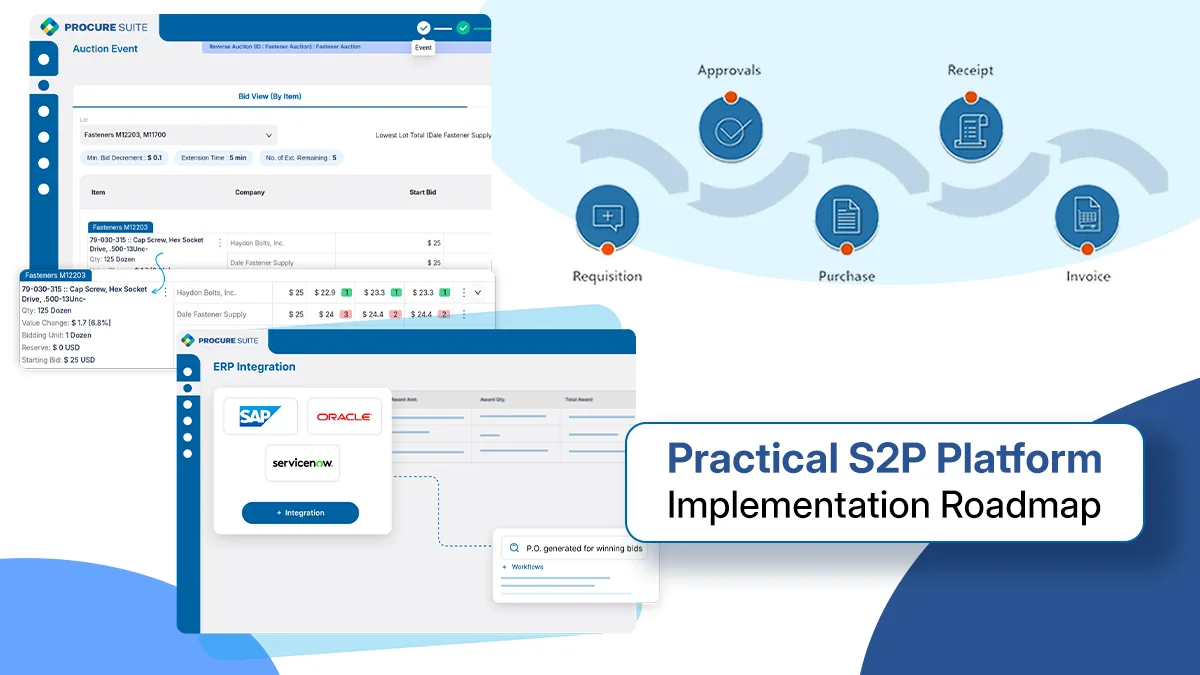
Both source-to-settlement (S2S) and source-to-pay (S2P) terms are used interchangeably in the corporate world. When you want to handle the S2S process effectively, source-to-pay software remains useful. However, the successful implementation of this software is essential to leverage its benefits. This post talks about the practical roadmap for effective S2P platform implementation.
Before moving ahead, let’s understand the scope of S2S in the procurement lifecycle.
Introduction and Scope of S2S in Procurement
S2S, or source to settlement, is an umbrella term that covers the entire procurement lifecycle. It takes care of several processes, including
Strategic sourcing
Contract management
Purchase orders and requisitions
Goods receipt
Invoice Processes
Payment settlement and statement
An integrated source to pay platform can handle all these stages in a single, uniform workflow. It can control approvals and offer real-time visibility to companies. Simply put, it creates one source of truth from supplier selection to payment.
Operational Challenges to Address before Selecting S2P Platform
Choosing the right platform is essential for addressing specific operational issues. In our experience, most organizations face visibility gaps. They cannot get satisfactory answers related to spending, supplier behaviors, and negotiated contracts. This lack of visibility leads procurement to a reactive process where decision-making depends on assumptions rather than insights.
The second issue is weak controls and inefficiency. Enforcement of policies requires a focused approach and proper governance. The lack of governance can lead to inconsistencies. Moreover, manual approvals and invoice mismatches are several other issues responsible for slowing down operations and increasing costs. These issues become more complex over time and bring frustration for various teams.
It is fair to say that companies need to identify and prioritize these real problems clearly before choosing the S2P solution. They need to address such issues to get measurable results from the source-to-pay solution. Let’s dig deeper into the ways to choose the right S2P software.
How to Choose the Right Source-to-Pay Software
After addressing the operational issues, the next step is to compare the available source-to-pay solutions. Some of these solutions are sourcing-heavy and focus on RFQs, negotiations, etc. Some platforms are suitable for large enterprises with complex structures, while others are beneficial for mid-sized organizations. You can select the one as per business priorities. The key here is to consider your current needs and plans.
You can start with functionality. Your source to pay procurement software should have end-to-end capabilities like P2P automation, supplier management, eSourcing, and analytics. It should have robust integration capability as well. Another factor you should consider is user experience. Finally, it is important to consider budget and deployment speed. Some solutions may take a few months, while others go live in a short time.
Once selected, you should implement it in a way to leverage its advantage. Here, we give a step-by-step guide for the effective implementation of the S2P solution.
Step-by-Step Guide for Effective Implementation of S2P Software
The successful S2S process needs advanced S2P software. However, it starts with effective implementation. Here are the steps to ensure that your selected source to pay platform delivers measurable value without any disruption.
Step 1. Keep Stakeholders on the Same Page
A successful implementation process starts with keeping all the departments, including finance, IT, and operations, in sync. Finance can ensure budget alignment, and IT manages integrations securely. Operations can offer ground-level insights. Failure to keep stakeholders aligned may result in resistance after the go-live.
Step 2. Map and Measure Existing Workflows
Proper documentation of the existing workflow can take companies a long way. Before configuring the S2P system, it is important to understand how things work currently. It also revealed hidden inefficiencies. Once your company has the complete report on existing workflows, an s2p platform can standardize them more effectively.
Step 3. Structure and Standardize Supplier Data
This is one of the most important steps. Many companies ignore data governance while implementing the S2P system. However, it is critically important because inefficiencies in data can lead to massive errors during automation. Therefore, it is essential to standardize supplier information and remove duplicates before launching source to pay solutions.
Step 4. Focus on Core Modules of the Solution
A phased approach can work here. It reduces complexity and improves adoption. You can start with high-impact modules like requisition-to-PO workflows and invoice automation. Once things get streamlined, you can expand into strategic sourcing and integration of contracts. Finally, advanced analytics can take place after reliable data starts flowing through your system.
Step 5. Prioritize Adoption with Deployment
Implementation can make half the job done! Real success lies in user adoption. It is, therefore, necessary for teams to understand the benefits and usefulness of the S2S system. Companies can provide their procurement teams with scenario-based training and share early performance wins. Even the most advanced source-to-pay software requires the user’s support.
Step 6. Measure the Outcome and KPIs
You should define success metrics before going live. You can track approval cycle times and supplier lead times. Such KPIs are useful to measure the impact and justify the investment. Apart from this, continuous monitoring plays a vital role in ensuring long-term improvement in the system.
Handling these steps with discipline and proper planning can lead to effective S2S implementation. This drives a structured transformation in your procurement process.
Common Mistakes that Hinder the Benefits of S2S
Lack of discipline and other common mistakes can hit hard on companies that have advanced S2S solutions in place. One such mistake is excessive tweaks in workflows. It leads to more complexity and slow deployment. Another critical mistake is ignoring change management. People usually resist unfamiliar systems, especially when they bring disruptive changes in routine activities. Here, the lack of proper communication and training can ruin the benefit.
Finally, weak governance can erode progress. You need to implement sustainable and standard practices to ensure the success of S2S processes. The best s2p tools can assist you in it, but companies need to take steps to remove common mistakes.
Concluding Remarks
The successful sourcing-to-settlement process depends on feature-rich source-to-pay software. It unifies procurement into a single system. However, it is essential to avoid some common mistakes and address several operational challenges to leverage the benefits of S2P solutions. It can help your organization drive value through an effective procurement lifecycle.
Procure Suite, a robust source-to-pay procurement software, combines processes from sourcing to payment in a single platform. It contributes to increasing efficiency and ensuring sustainability by enhancing compliance and offering more visibility. Contact us to schedule a demo and understand the role of Procure Suite in processes ranging from sourcing to settlement.