Overview
Let’s face it. Manual sourcing can slow you down as emails and spreadsheets get obsolete. This is a reason companies are evaluating ‘request for quote software.’ We will start with RFPs or requests for proposals. They were never meant to live in inboxes. However, many procurement teams still manage sourcing using RFPs. The result? Well, missed responses, compliance risks, and slow decisions. There, RFP software solutions come into play.
This guide walks you through the benefits of RFP software and how you can implement the right RFP procurement software for your business.
Let’s have a reality check.
Why Traditional RFP Processes Break Down
Manual or traditional RFP management creates friction at every stage when sourcing volume grows. The real problems for the procurement teams include—
Different formats of supplier responses
Difficulty with version control
Outdated data for the stakeholders
Changes in evaluation criteria
Incomplete or missing audit trails
In our experience, this slows sourcing and weakens negotiation opportunities. RFP automation software can handle these challenges effectively as a strategic tool.
RFP Software vs. Manual RFQ Management
Simply put, RFP software solutions are purpose-built platforms that bring automation to the process. When it comes to manual RFQ management, it may create confusion and chaos. Here are the points of comparison between RFP software and manual RFQ management.
Characteristic | Manual RFQ | RFP Software |
|---|---|---|
Supplier communication | Email threads | Centralized Portal |
Response formats | PDFs, Excel | Structured Templates |
Evaluation | Manual Scoring | Automated |
Collaboration | Offline Reviews | Real-time Stakeholder Access |
Audit readiness | Low | High |
Cycle time | Weeks or Months | Days or Weeks |
This results in more visibility and control when you opt for an RFP solution. Let’s understand when it is essential to choose the best RFP management software.
When Do You Need RFP Procurement Software?
Here is the fact- not every organization needs enterprise-grade tooling on day one. However, here are the situations when your company needs an RFP solution:
High-value or complex sourcing events
10+ suppliers per RFQ
Compliance and auditability are in focus
Involvement of multiple teams in supplier evaluation
Data-driven award decisions are necessary
All these circumstances indicate the need for the right RFP management solution.
Key Features of the Best RFP Management Software
Companies should consider the following features to choose the most suitable RFP management solution-
- RFQ & RFP Templates
Pre-built templates are useful for running consistent sourcing events. This can reduce setup effort, ensuring suppliers respond to the same requirements.
- Automated Scoring & Weighting
The system can score bids from suppliers automatically on the basis of predefined criteria. It can remove bias and help teams focus on competitive suppliers.
- Collaboration & Approvals
Internal stakeholders can review, comment on, and approve RFPs within the platform, eliminating delays in answering the emails.
- Complete Audit Trails
This is one of the most useful features that ensures compliance and traceability. It logs every action, ranging from bid submission to final award.
- Bid Comparison
Side-by-side bid comparison enables procurement teams to compare quickly and more accurately the prices, terms, and capabilities of suppliers.
- Dedicated Supplier Portals
Suppliers can submit bids using a centralized portal with defined fields. It ensures that responses remain easier to review, compare, and validate.
A feature-rich RFP automation software can bring all these features to the table to digitize sourcing and streamline processes.
How RFP Automation Improves Strategic Sourcing Outcomes
Automation in RFP can improve sourcing outcomes. Here are the top benefits of RFP automation software for strategic sourcing:
- Quicker Cycles
Automation can reduce manual follow-ups and consolidate responses in real-time.
- Better Decision
Structured data enables companies to compare suppliers objectively to make better decisions.
- Stronger Negotiations
Clarity in price breakdowns and commercial terms leads to stronger negotiations.
- Reduced Risk
Audit trails and approvals can reduce sourcing-related risks significantly.
Here, it is fair to say that you should choose a robust request to quote software with the necessary features.
RFP Software Implementation Plan Before You Start
Let’s be honest. Tools do not fix broken processes. It is, therefore, necessary to stick to basics before rolling out the RFP software solution. These tips include cleaning up supplier master data and standardizing evaluation criteria. Moreover, it is necessary to define the approval workflows that you want to automate and train internal reviewers accordingly. Finally, it is always better to start simple before you scale the RFP solution.
Real-Life Use Cases of RFP Software
The procurement process needs advanced tools and techniques to gain an advantage. Advanced RFP software can prove its value in different ways as per changing business needs. Let’s understand it through real-life scenarios.
Use Case 1—SaaS Company
RFP software standardizes supplier evaluations and reduces sourcing cycles. It also gives clear visibility into supplier selection decisions to the leadership. This contributes to the growth of a SaaS company.
Use Case 2—Manufacturing Enterprises
Manufacturers who need to run RFQs for direct and indirect materials frequently can rely on RFP software. It enables them to compare bids side-by-side and ensures compliance through complete audit trails.
Use Case 3- Service Firm
Structured RFP workflows reduce dependency on individual buyers to create consistent sourcing processes in the mid-market services firm. This can handle repeatable sourcing activities effectively.
RFP software can take sourcing and procurement processes to a new level in core industry sectors. However, it is essential to integrate it into the procurement tech stack to get the optimum result. Some of these integrations are ERP or finance systems, contract lifecycle management (CLM), and source-to-pay (S2P) or procure-to-pay (P2P) suites. An integrated RFP solution can handle multiple sourcing activities more accurately and effectively.
Concluding Remarks
When your sourcing decisions affect cost or business growth, manual RFP processes can be a bottleneck. The right request for quote software can replace fragmented workflows with speed and transparency when simplifying complexity. In summary, the right RFP solution can meet the diverse procurement requirements while giving the flexibility to scale as and when necessary.
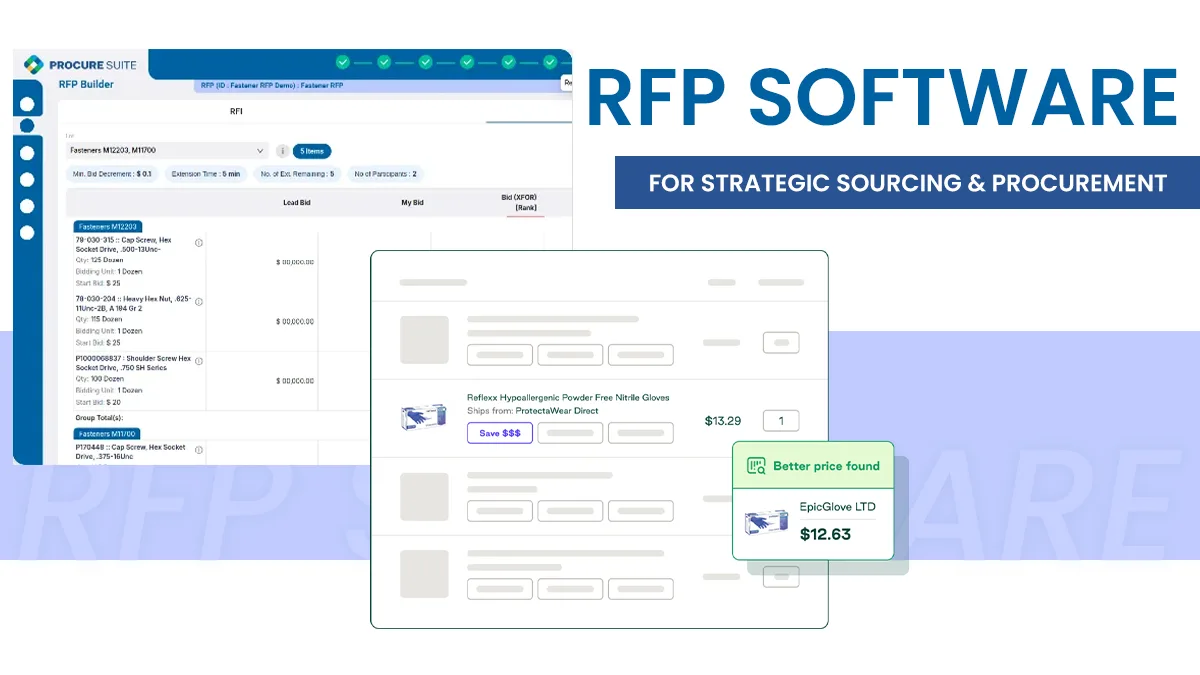
Procure Suite is one of the best RFP management software solutions. It assists modern companies to get rid of time-consuming RFP-RFI-RFQ processes with the utmost flexibility and scalability. Schedule a demo to learn how the Procure Suite assists you in improving collaboration and enhancing supplier selection.