Overview- How Reverse Auctions Save Costs
Reverse auctions can optimize procurement costs significantly by enabling buyers to drive competitive pricing. This powerful model has gained popularity because of its capability to save anywhere from 18 to 40 percent for any organization. However, while we can achieve these savings under certain conditions, we cannot guarantee them in every sourcing event. Factors including market competition and supplier readiness are some of the cost-affecting factors.
Here, advancing technology can lend a helping hand to achieve high savings while managing reverse auctions effectively. Robust reverse auction management software enables companies to execute the process systematically and transparently. This solution can simplify the complexity of reverse auctions and increase the efficiency of the procurement process. This post talks about the role of reverse auction process management in saving costs.
Let’s start with the overview of reverse auction processes that can give up to 40 percent savings.
Where Savings Up to 40 Percent are Realistic through Reverse Auctions
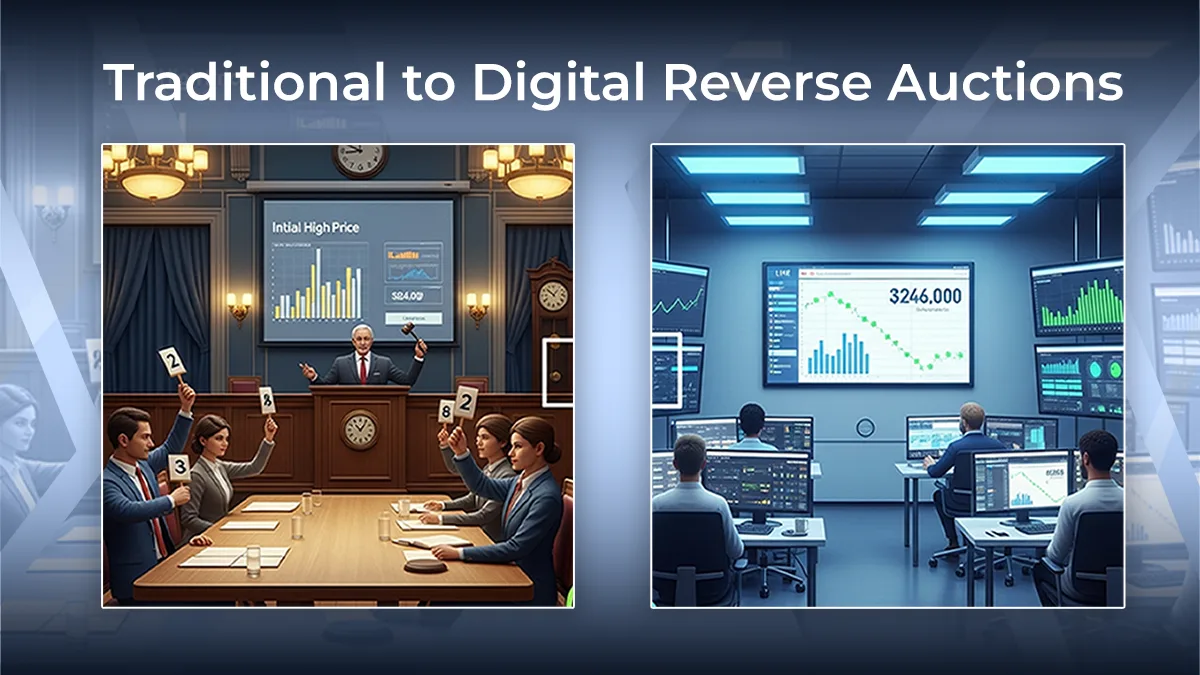
A reverse auction is different from the traditional bidding model because it enables suppliers to compete in real time. A reverse auction system creates transparent and time-bound competition that compels suppliers to offer their best possible prices. Modern enterprises can manage reverse auctions with predefined rules, criteria, and compliance controls, making them scalable and auditable using the advanced tools.
Reverse auctions are highly useful for different industry sectors, including manufacturing, logistics, packaging, IT, and MRO (Maintenance, Repair, and Overhaul). Cost efficiency and speed play a vital role in all these industries. When reverse auction in procurement is applied to the right categories and market conditions, companies can get savings up to 40 percent. Moreover, high-competition supplier markets, like commodities and services, are significant beneficiaries of reverse auctions.
Here, it is fair to say that predefined and standardized auction requirements enable suppliers to compete on price rather than assumptions. A reliable reverse auction platform ensures fair but aggressive bidding. Moreover, short-term or volume-based contracts can unlock deeper discounts. It is because suppliers remain ready to reduce margins in exchange for guaranteed business.
Categories Where Reverse Auction Works
Not all kinds of things should be sold. This matrix will help you decide where to put the Procure Suite e-Auction Module.
Category Type | Suitability | Why? | Estimated Savings |
|---|---|---|---|
Raw Materials | High | Specs are chemical/physical standards. Easy to switch. | 12% – 18% |
Freight & Logistics | High | Routes are standard. Capacity is the main variable. | 15% – 25% |
IT Peripherals | High | Laptops/Servers are commodities with fixed specs. | 18% – 22% |
Marketing Print | Medium | Good for bulk printing, bad for creative design. | 20% – 40% |
Construction | Low | Too many unforeseen variables. High risk. | Highly Variable |
Professional Services | Low | You are buying "brains," not widgets. | N/A |
In purchasing raw materials, reverse auctions suit well. It helps save around 12% - 18% of costs. This is because set specifications are given.
Reverse auctions are also useful in the freight and logistics category. The reason is that routes are standard; only the capacity of goods varies. The estimated savings range from 18% to 22%.
Even for IT peripherals, companies can use reverse auctions, as the suitability is high, resulting in estimated savings of 18% to 22%. In this category, the commodities have fixed specifications.
Though the suitability of reverse auctions is medium in the marketing print category, it gives an estimated savings of 20% - 40%. It is noteworthy that reverse auctions are good for bulk printing but do not work for creative design.
However, reverse auctions’ suitability is low in construction and professional services.
Savings are highly variable in the construction sector, as it has many unexpected variables.
As for professional services, the savings aspect does not apply. This is because businesses buy services and not widgets.
Let’s go through the areas or domains where reverse auctions can backfire.
Where Reverse Auctions Do Not Work
Reverse auctions are not a one-size-fits-all solution for sourcing. When applied wrongly, they can give subpar outcomes. Let's take an example of complex categories. Consulting and R&D are such categories. Here, it is not possible to force service providers into price-only competition. Such services rely heavily on expertise and long-term value rather than price. Moreover, this system is way less effective in markets with a limited supplier base.
When companies do not give priorities to quality and supplier relationships, reverse auctions can fail to serve their objectives. Excessive price pressure can make suppliers stay away or compromise on the overall quality. It leads to performance issues or contract non-compliance over time. Moreover, if auctions are purely transactional or adversarial, they may damage supplier partnerships.
A robust reverse auction system can enforce governance to ensure complete specifications and maintain transparency. Organizations risk post-award disputes and savings with other challenges without effective reverse auction process management. Let’s understand the role of the reverse auction solution in savings.
Role of Reverse Auction Management Software in Savings
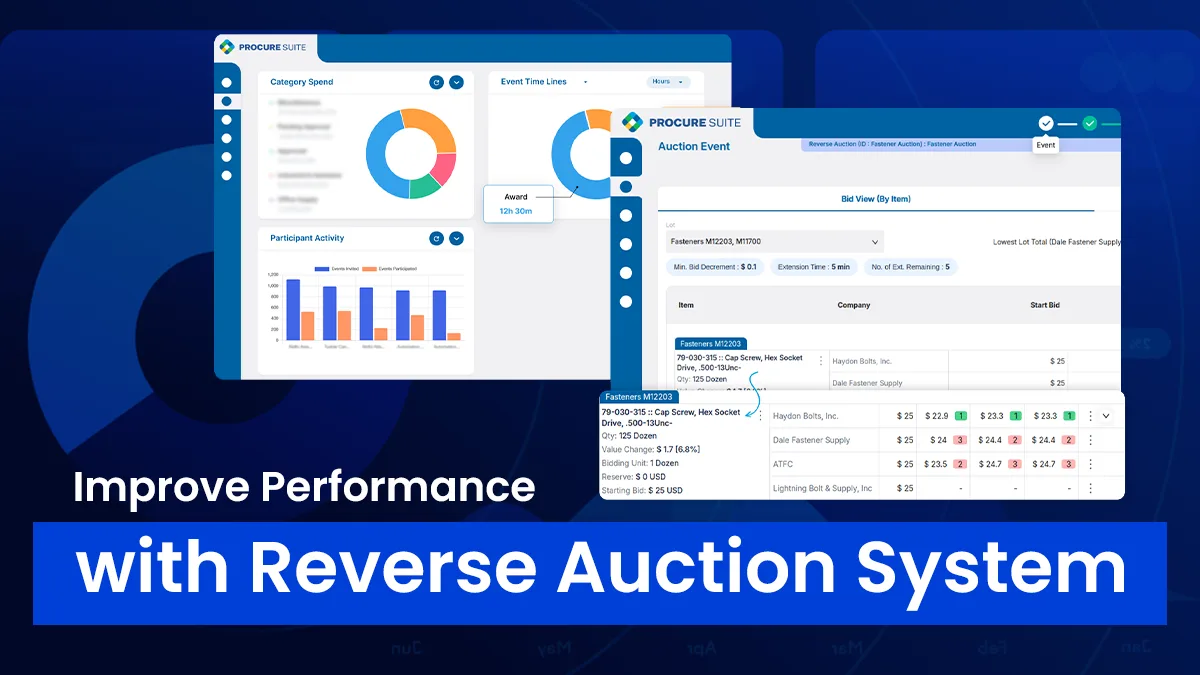
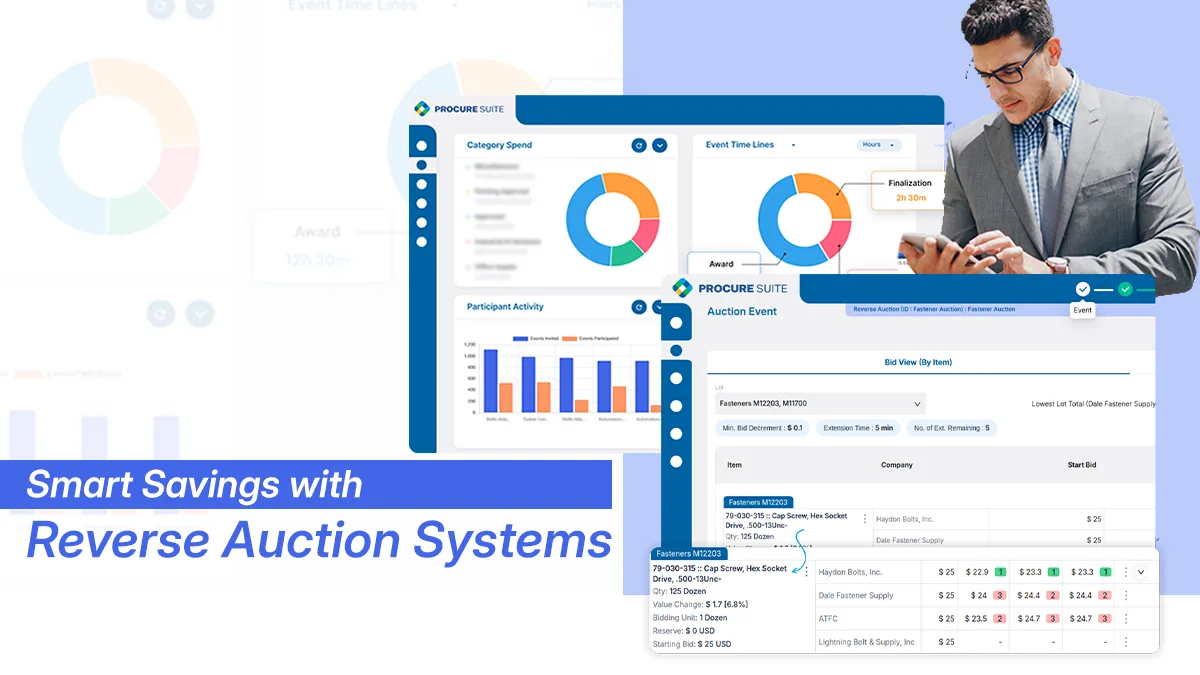
An advanced reverse auction management system can turn competitive bidding into measurable savings by bringing transparency and automation. It gives companies more control, streamlining the auction process. It standardizes auctions to ensure that the competition happens under preset rules. Features including real-time bid visibility, supplier qualification checks, and audit-ready logs can create fair competition among suppliers without any errors.
Furthermore, reverse auction management software can increase savings through improving data governance and analysis. Its inbuilt analytics help procurement teams assess bidder behavior, comparing awarded prices against historical benchmarks and market rates. Moreover, its seamless integration with sourcing, contracts, and supplier management systems brings negotiated savings. It ensures on-time delivery as well.
Finally, data insights enable smarter category selection and offer a better auction process to make more savings in the long-term procurement strategy.
Best Practices to Maximize Reverse Auction Savings
Companies must follow standardized and best practices for maximizing savings in reverse auctions. The entire process requires disciplined planning and careful execution. Procurement leaders can conduct supplier readiness assessments to ensure that suppliers understand the auction mechanics and technical requirements. It helps procurement managers avoid disengagement or non-competitive bidding.
Another factor is the type of reverse auction process. English auctions work well for highly competitive categories. However, Dutch or multi-attribute formats are better for processes with various scenarios and costing. Here, a robust reverse auction process management ensures that all structured decisions remain in line with organizational goals.
Additionally, organizations must think beyond price-related outcomes to drive more sustainability. They can combine cost with non-price evaluation criteria such as quality and compliance. This approach maintains a subtle balance between long-term value and competitive pricing. A modern reverse auction platform offers advanced analytics. It offers useful insights, including supplier competitiveness and bid behavior.
Companies can use these insights to refine their category strategies and enhance supplier engagement. This can transform reverse auctions from a cost-saving process to a strategic procurement enabler.
How Reverse Auctions Become Part of Procurement Strategy
A reverse auction in procurement processes can offer a more powerful impact. Integrating auctions with sourcing workflows and supplier performance programs can increase savings and streamline the entire process. Procurement teams can identify trends and drive continuous improvement by leveraging historical data from reverse auction management software. In other words, the reverse auction solution acts as a complementary tool in the broader strategy.
Concluding Remarks
Reverse auctions can deliver significant cost advantages with precision, governance, and the right technology. Companies can get savings of 18 to 40 percent in several standardized categories using the reverse auction process. However, high savings and success in the process largely depend on understanding the role of reverse auctions in procurement and sourcing strategies. It is necessary to ensure effective reverse auction process management by utilizing a robust system.
Procure Suite is one of the best online auction software for handling the reverse auction process. It helps enterprises maximize savings and reduce workload through a unique negotiation method. Contact us to learn more about our advanced reverse auction system by scheduling a demo.