



Overview
Many organizations struggle with disconnected systems, slow processes, and the inevitable mistakes that come with manual work. As a result, they cannot meet deadlines, maintain consistency, and meet market demands. Such challenges not only slow operations but also drain both time and money.
Thanks to modern technology, it has revolutionized the way organizations handle procurement. One such technology is a source to pay software. It offers a unified solution by bringing together everything in one place. This helps businesses simplify procurement, stay on top of compliance requirements, and start seeing a return on investment more quickly. Of course, rolling it out successfully requires a clear plan.
This post gives a comprehensive checklist to implement the software smoothly that saves time, reduces errors, and ensures high ROI. It will help companies streamline procurement, improve compliance, and maximize ROI from day one. First of all, we will look into the importance of the s2p software in procurement.
Why Source to Pay Procurement Software is Critical for Procurement Success
Source to pay software solutions have become increasingly important in procurement. The platform provides a single source of truth by bringing together the entire procurement lifecycle in one place. It starts right from sourcing and onboarding suppliers to managing contracts, issuing purchase orders, and paying invoices.
Teams do not have to use disconnected tools and spreadsheets. This enhances visibility and control across procurement and finance. Consolidating the procurement functions into one system helps minimize confusion and strengthen compliance. Thus, it provides a centralized source of information for the entire organization.
The benefits of a well-implemented system are worth mentioning.
Reduce manual errors and rework
Enforce policies and approvals automatically
Improve supplier collaboration
Gain real-time insight into spending and performance
Research shows that companies using s2p software can lessen procurement errors by up to 30%. It also speeds up invoice approvals and streamlines supplier onboarding.
The next question is- how can a business choose the source-to-pay solution that meets its needs?
Not all source to pay procurement solutions are equal. Selecting the wrong one can heavily affect procurement operations. That is why a comprehensive comparison of S2P solutions is necessary.
Comparison of Source to Pay Solutions- What You Need to Know
Here is a quick comparison of basic procurement tools with a full source to pay platform. Knowing these differences will help organizations make the right choice.
Feature | Basic Tools | Full S2P Platform | Why It Matters |
|---|---|---|---|
Supplier Management | Limited | Comprehensive | Better visibility and control |
Contract Lifecycle | Minimal | Automated & tracked | Lower risk and stronger compliance |
Analytics & Reporting | Standard | Advanced | Smarter, data-driven decisions |
Integration | Partial | Full ERP/CRM | Smoother workflows |
User Experience | Basic | Intuitive | Faster adoption |
When evaluating S2P platforms, organizations need to consider the following-
Compliance-heavy industries like pharmaceuticals or finance- A platform that automates audits, approvals, and reporting to maintain transparency and reduce risk.
Growth-focused organizations that want to scale- A platform with advanced analytics, supplier risk management, and integrated contract lifecycle management to boost efficiency and support smarter decision-making.
When organizations take these factors into account, they are much better positioned to choose a solution that truly fits their needs.
From there, the next step is about implementing the software smoothly.
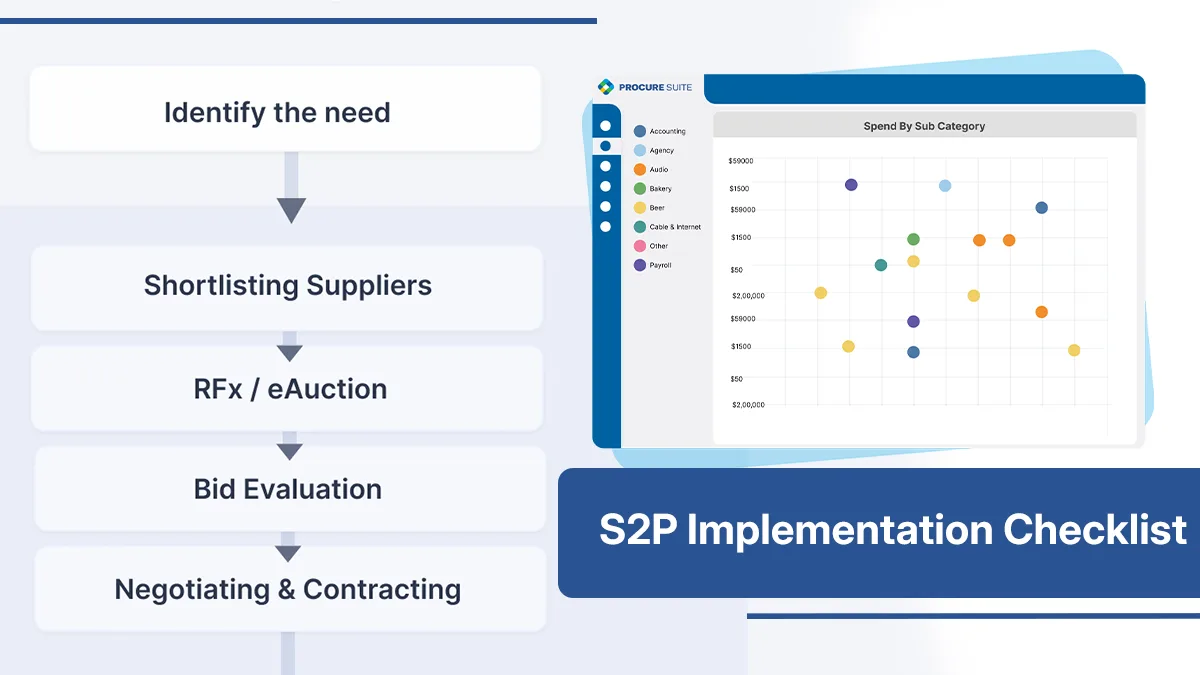
Source to Pay Software Implementation Checklist
At first, organizations might find it difficult to implement an S2P system. A structured, step-by-step checklist helps teams manage the entire process.
Step 1- Outline Clear Goals
First, organizations should bring their procurement, finance, and operations teams onto the same page. Before moving forward, teams should take the time to define what success really looks like and set clear KPIs, such as:
Reducing procurement costs
Speeding up supplier onboarding
Shortening invoice processing times
When everyone agrees on these goals from the start, it creates a shared vision and clear expectations across the organization.
Step 2- Map Current Processes
Organizations need to document current workflows from start to finish. This helps to find out the bottlenecks and redundancies. With flowcharts, they can find out which areas need automation to save time and effort.
Step 3- Clean and Standardize Data
As accurate data is important, companies need to verify supplier profiles, contracts, and payment details before migrating them into the new system. Although it requires some effort, cleaning and standardizing data prevent errors, eliminate duplicates, and ensure reliable reporting from day one.
Step 4- Select the Right S2P Platform
Companies need to assess solutions with regard to functionality, scalability, integration, and ease of use. The right source to pay platform automates and streamlines processes across sourcing, contracting, purchasing, and payments.
Step 5- Test Your System
Businesses need to test the system before launching it fully; they can do so by running pilot projects involving a few suppliers and internal users. They can then spot any issues early, thereby making adjustments to workflows, approvals, and reporting before the full rollout.
Step 6- Help User Adoption
Even the most powerful software fails if people do not use it. Hence, organizations should impart training so everyone knows how the system works. Moreover, ongoing support, clear instructions, and quick feedback help build confidence and keep users engaged.
Step 7- Track Metrics
Organizations need to monitor key metrics, including cost savings, cycle times, and compliance. Using dashboards and real-time reports, teams can identify potential issues early, make the necessary adjustments, and keep everything in control.
Step 8- Continuous Improvement
Implementation is not the end. To get the most out of the solution, companies need to improve it regularly. Using analytics and feedback, organizations can refine strategies and contract management to build stronger supplier relationships.
Expand Source to Pay Platform for Maximum ROI
After the S2P system starts operation, organizations can add advanced capabilities that can drive even greater value. For example-
Contract Lifecycle Management helps streamline contract creation, approvals, and renewal. It reduces risk while keeping everything compliant.
Supplier Risk Analytics provides early visibility into potential risks, allowing teams to address issues before they impact operations.
AI-Powered Procurement Insights- It suggests cost-saving opportunities, predicts supplier performance, and optimizes procurement strategies.
Beyond improving procurement processes, these enhancements give finance teams a clearer view of cash flow. Sourcing experiences fewer delays, and compliance teams can generate audit-ready reports in minutes.
Concluding Remarks
Source to pay software is not just another tool. It transforms procurement into a strategic, efficient, and compliant process. The software provides clear benefits, which are faster workflows, reduced errors, better visibility, and measurable ROI. By following a structured checklist and taking a thoughtful approach, companies can turn a source to pay system into a real competitive advantage.
Procure Suite is a robust source to pay software that enhances efficiency and ensures sustainability in procurement processes. It handles sourcing, payments, and core procurement processes effectively. If you want to know how Procure Suite can support your goals, get in touch with us to schedule a demo.