Overview
Enterprise Resource Planning (ERP) transforms the procurement cycle. It is useful to remove data silos, bring workflow automation, and offer real-time visibility. As a result, modern companies make more insightful decisions with reduced chances of manual errors. This blog explores the ways ERP integration makes procurement a strategic move.
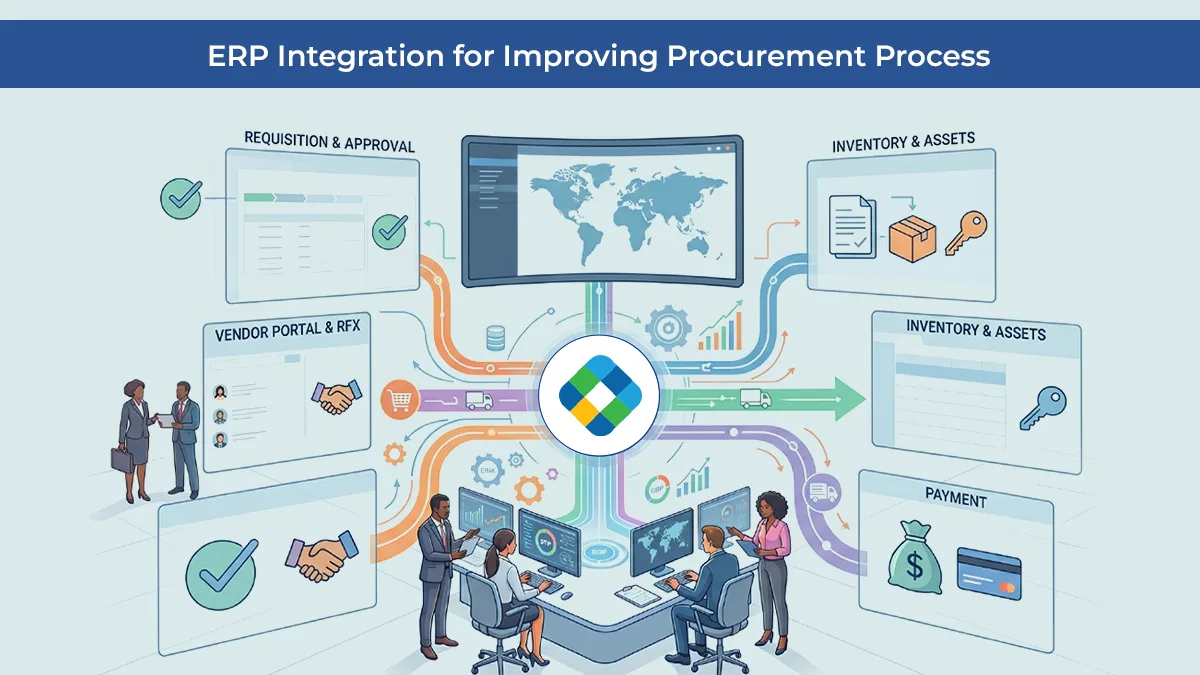
ERP plays a vital role in planning and managing resources in enterprises. When we integrate with an advanced procurement process management software, it creates a connected system that streamlines the cycle.
Let’s face it. Most procurement teams face hurdles due to using separate tools for different processes. For example, companies have software for supply chain management and a separate e sourcing platform. Some companies use an enterprise procurement software with a supply chain management tool combination. Such disconnected systems result in duplicate data entries and poor supplier visibility
In our expertise, disconnected execution results in 60 to 70 percent inefficiencies in companies. Let’s dig deeper into the changes ERP brings when integrated into eProcurement solutions.
ERP Meets Procurement- Importance of Integration
ERP makes the procurement process data-driven and enables companies to sync finance, inventory, and sourcing in real time. Companies can make every purchase decision according to budget and demand. Simply put, ERP makes procurement solutions a complete tool with the necessary functionality.
Here is a quick table of comparison between ERP-integrated and non-integrated procurement systems.
Feature | Without ERP Integration | With ERP Integration |
|---|---|---|
Data Flow | Manual & Fragmented | Automated & Unified |
Approval Cycle | Slow, email-based | Workflow-driven |
Supplier Insights | Limited | Real-time analytics |
Cost Control | Reactive | Predictive & controlled |
Compliance | Risk-prone | Built-in governance |
Scalability | Difficult | Seamless |
When it comes to scaling the enterprise, ERP integration into procurement process management software is essential.
How ERP Integration Improves Procurement
ERP integration can improve the entire procurement cycle. It offers several benefits to the procurement team. Here are the top ways ERP integration helps the procurement process.
Real-Time Data Visibility
ERP integration enables companies to avoid spreadsheets and fragmented or manual reports. They can run the procurement cycle with live data. Also, ERP offers spending and supplier performance monitoring in real time. Enterprise procurement software with ERP can deliver real value with complete visibility and control.
Automated Workflows
Manual approvals in procurement can lead to sluggishness. Moreover, it can slow down the entire procurement cycle. ERP integration, on the other hand, can eliminate this issue by workflow automation. It assists companies in routing purchase requests automatically. It makes it possible to record every action for auditing. As a result, companies can reduce errors and decrease their cycle times.
Smarter Sourcing
When ERP integrates with e sourcing platforms, companies can shift the sourcing process from reactive to proactive. They can compare supplier bids in real time and access historical data. This facilitates companies making decisions based on insights. The best esourcing software can give the advantage of smarter sourcing with a competitive edge. Companies can also gain more through effective supplier negotiations.
Accurate Budgeting
ERP integration bridges the gap between the procurement and finance departments. Enterprises can get more control over budgets and prevent overspending effectively. ERP is also beneficial in giving an idea of procurement budgets with higher accuracy. Simply put, ERP can keep companies in control throughout the procurement process while monitoring committed versus actual spending.
Supply Chain Synchronization
A customized software for supply chain management can remain highly effective in integrating with ERP. When this integration combines with enterprise procurement software, it can convert operational efficiency into measurable ROI. Procurement works according to demand planning and supply chain management software with ERP. This can streamline logistics and purchasing. As a result, companies can scale their businesses without increasing complexity.
In a way, ERP can enhance the procurement process through smarter sourcing and accurate budgeting. Let’s understand how ERP integration can make a difference in various businesses.
Real-Life Use Cases of ERP Integration
Here is an example of a growing technology company. It faces chaos, delays, and overspending without integrating ERP. Here, ERP integration brings au approvals, rapid vendor onboarding, and more financial control.
Another example can be a manufacturing company. It heavily depends on supply chain coordination. The lack of ERP may result in stockouts or over-ordering. However, with ERP, the demand-driven procurement cycle remains in line with production.
However, it is essential to choose the right procurement solution with an integrated ERP to leverage its benefits.
How to Choose the Right Enterprise Procurement Software with ERP Integration
Choosing the right enterprise procurement software with integrated ERP is a crucial decision. It requires a clear understanding of business requirements. The selection process starts with determining the existing procurement workflow. For example, you need to identify the challenges and characteristics of the procurement cycle.
You should consider that your procurement process management software should sync with the ERP to maintain data flow across various departments. In our experience, companies over-prioritize feature lists and ignore integration depth. It leads to expensive tools that are not worth handling procurement operations effectively.
Apart from these factors, companies should focus on usability, scalability, and intelligence. The right solution should have the necessary features like supplier performance monitoring, configurable approval workflows, etc. Moreover, it is important to ensure that the system remains in line with the overall supply chain management strategy. The best esourcing software should also be easy for the team to adopt and flexible to grow with a scaling business.
Concluding Lines
ERP integration can transform the procurement process. However, companies should choose the right enterprise procurement software. The software should come with seamless connectivity and integration capabilities. Such a solution helps companies eliminate data silos and automate workflows. It also creates a single source of truth across different departments. ERP-integrated e sourcing platforms should be in line with software for supply chain management.
This solution eliminates data silos and automates workflows. It improves decisions, relationships, financial control, and procurement operations. ERP integration takes the procurement process to a new level. It combines various departments while enhancing supplier collaboration. A reliable partner helps modern companies get an advanced solution with a combined functionality of ERP and procurement.