Overview
An invoice says 100 units. The goods receipt note (GRN) says 95. Catching the gap takes a person reading two documents side by side, and your team does the same kind of checking when it reviews vendor documents, compares RFP submissions, processes purchase requests, and matches invoices to GRNs. AI agents take on that collecting and verifying work, so your team spends less effort on it and gets to the information faster.
These agents interpret instructions, work with your business information, and finish assigned tasks within the permissions you set. ProcureSuite is AI procurement software built around four agents: Doc Extraction & Summarization, RFP Response Evaluation, Interactive Requisition Guide, and SmartDoc Match AI. Each one covers a different stage, and each leaves the final decision with you.
What is Agentic AI in Procurement?
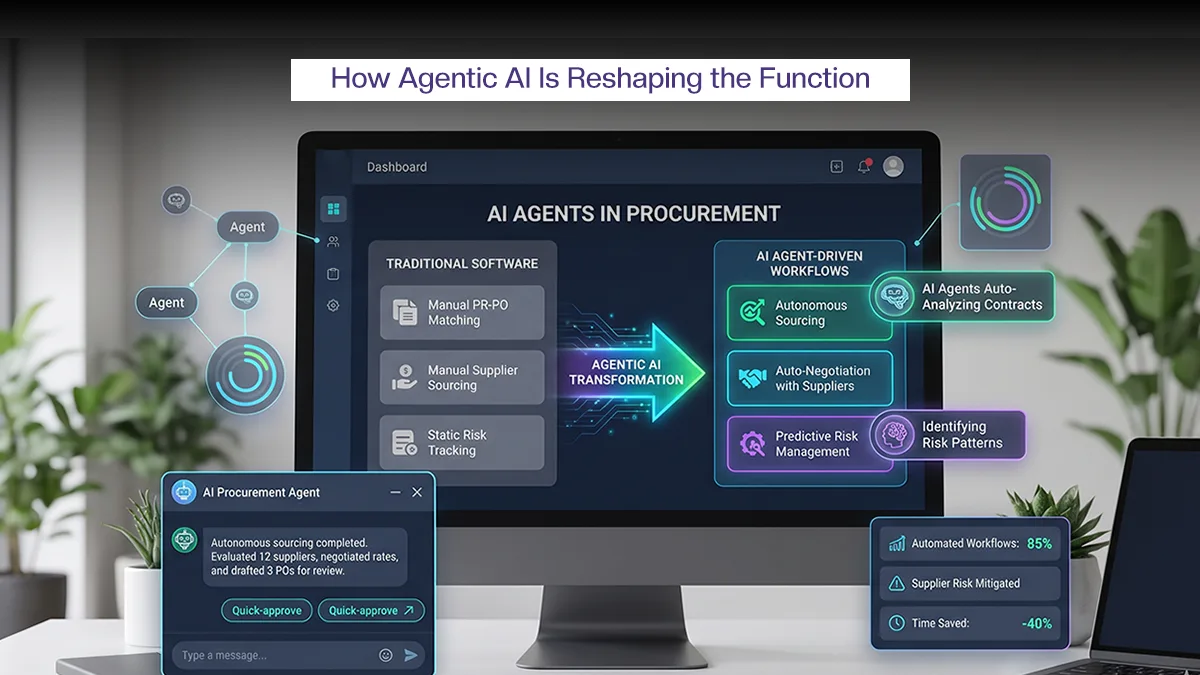
Agentic AI in procurement means AI systems that take a defined objective, read the relevant information, plan the steps, and act within boundaries you assign. AI agents in procurement work with vendor documentation, RFP submissions, product catalogs, and purchasing information.
Traditional automation follows fixed conditions to finish repetitive tasks. An AI assistant answers your questions and follows your instructions. Procurement AI agents read the business context and carry out connected steps, within the configuration and system access you give them.
Take an agent that reviews vendor proposals. It extracts the significant details and compares each response against your evaluation criteria; a procurement manager then reviews the findings. That cuts the time spent preparing information, and the business decision stays under human control.
Four Procure Suite Agents and the Work Each One Takes on
Doc Extraction & Summarization: Simplifying Vendor Document Reviews
Vendor documents come with lengthy descriptions, commercial terms, technical specifications, and compliance information. You have to find the necessary details before you can compare suppliers or write an internal report.
ProcureSuite’s Doc Extraction & Summarization agent extracts key information from complex vendor documents and writes concise executive summaries.
Say a mid-sized manufacturer gets proposals from five suppliers for hydraulic valves. One quotes per unit and another per carton of 50. One states delivery in days and another in weeks. Each also lays out product specifications and company details in its own format. The agent extracts that information and writes a summary of each, so the procurement manager sees all five submissions on the same footing.
You read fewer documents start to finish, and you reach vendor information sooner. That frees time for the commercial terms and for chasing down missing information.
RFP Response Evaluation: Making Supplier Comparisons Easier
An RFP submission carries technical responses, delivery commitments, warranty conditions, and other requirements from the request, plus the quoted price. You need to examine all of them.
ProcureSuite’s RFP Response Evaluation agent scores and compares vendor submissions against your defined evaluation criteria and analyzes the results. It helps you review responses more consistently and identify differences that need a closer look.
Suppose a plant is buying a CNC milling machine and gets proposals from four suppliers (illustrative figures). Supplier A quotes $182,000 with 16 weeks to delivery and a 12-month warranty; Supplier B quotes $196,000 with 10 weeks and a 36-month warranty. The agent scores all four against your evaluation criteria and presents the results, so you can judge whether B’s shorter delivery and longer warranty are worth the extra $14,000.
That is AI sourcing in practice: less manual comparison and a quicker route through supplier responses. You still decide the award, and it goes through your approval process.
Interactive Requisition Guide: Simplifying Purchase Requests
Purchase requisitions start with employees who may not know the procurement policy or the approved catalog, and may not know what a complete request needs. Purchase Requisition Software helps guide employees through the request process, ensuring submissions are complete and aligned with procurement policies. Incomplete requests mean repeated clarification and slower approvals.
The Interactive Requisition Guide is an intelligent assistant that walks requesters through product catalogs and requisition workflows.
An employee who needs office equipment asks the guide, finds the right product in the available catalog, and continues straight into the purchase request. The request reaches procurement with the appropriate product information already in it.
Guided requests mean fewer incomplete submissions and less back-and-forth between employees and your procurement team. Connect the guide to your purchasing policies and approval workflows, and it also supports AI procurement automation, with authorization requirements still in place.
SmartDoc Match AI: Improving Invoice and GRN Reconciliation
Invoice verification involves procurement and finance comparing supplier invoices against receiving records and other purchasing documents. A mismatch in quantities or prices on any line item delays reconciliation and creates follow-up work.
ProcureSuite’s SmartDoc Match AI automates invoice and GRN data extraction, then handles the matching and line-item reconciliation.
Take the 100-versus-95 gap from the top: a supplier invoices you for 100 units of a component, and the GRN records 95 received. SmartDoc Match AI extracts the information from both documents and compares the line items; the 5-unit quantity difference goes to the responsible team for review.
Your team checks fewer lines manually and finds discrepancies earlier. In the wider procure-to-pay process, accurate matching is what lets procurement and finance work through invoice exceptions.
What You Get From AI Procurement Software
AI procurement software cuts manual steps in four places: document review, proposal comparison, requisitions, and invoice checks.
Less repetitive work: Extracting documents, comparing proposals, guiding requisitions, and checking invoices each take fewer manual steps.
Faster processing: Because the information arrives organized, your team does not review every document from the beginning.
Better information accuracy: Structured extraction and document comparison also surface missing details and discrepancies, so someone can review them.
Improved process visibility: Procurement and finance work from clearer information, whether they are reviewing supplier submissions and purchase requests or invoice records.
Your results depend on document quality, system connections, how you evaluate the agents’ output, and how your organization manages human approvals.
Five Checks Before Adopting Agentic AI in Procurement
Procurement automation with AI needs reliable information and clear workflows in place first, plus defined permissions for each agent.
Document quality comes first. Proposals and invoices need readable, consistent information, and so do receiving records. Poor-quality scans or incomplete documents affect extraction results.
Evaluation criteria need to be defined. RFP evaluation requires clear scoring parameters, so decide how much pricing, technical compliance, delivery, warranty, and other requirements matter before you use AI-assisted comparisons.
Your systems need to be connected. Agents need access to the relevant procurement information, and connections to your ERP, purchasing, supplier, and finance systems cut repeated data entry and support connected workflows.
Set access and approval controls. Give each agent permissions that match its assigned responsibilities; supplier awards, purchase commitments, and payment approvals should follow your organization’s established authorization process.
Keep a human in the loop. Keep the summaries and comparisons an agent produces, plus its discrepancy reports, available for verification. Your team investigates the exceptions and makes the calls that carry commercial risk.
The Future of Procurement: Moving Towards Agentic Procurement
The next stage of AI in procurement will see AI agents teaming up to manage related processes throughout the procurement cycle. In other words, rather than dealing with different processes in silos, there will be greater integration of information between agents. For instance, information acquired from vendor documentation will assist with RFP analysis, and requisition information will assist with procurement checks.
This makes it possible to have agentic procurement where several agents deal with the various phases of the purchase process. There could be a document extraction agent that organizes information on suppliers, an evaluation agent that evaluates the responses of vendors, and an invoice matching agent that helps in reconciling any discrepancies. With the integration of such processes with procurement and ERP systems, there will be minimal duplication of effort and better visibility into purchase processes.
Another area of growth is predictive procurement. AI-powered agents will use historical purchase data, supplier performance, and pricing trends and demand to identify potential problems before they impact business processes. Your team gets alerts of any odd changes in prices, supplier deliveries, and non-compliant spend early on. Such data can guide you in negotiation and addressing the challenges in supplies.
The role of procurement professionals will also continue to change. Teams will spend less time collecting information and checking documents, giving them more time for supplier negotiations, category planning, contract decisions, and exception management. With the development of autonomous purchasing, there will be a need for clear guidelines to indicate the tasks that agents should perform on their own. Supplier awards and financial approvals continue to receive the approval of human beings.
Businesses benefiting the most from AI procurement software will be those that align the skills of the agents with dependable data on procurement, well-tested procedures, and sound decision controls. That way, they will make progress not just from task automation but from process optimization.
Next Steps
If you are moving toward autonomous procurement, start with the task that eats the most time in your current purchasing workflow. Vendor document reviews, RFP comparisons, incomplete requisitions, and invoice reconciliation are the four to check first. Pick one and write down the rules for completing it; then add AI assistance with review and approval controls in place. Now you will know quickly whether the agent got it right.
Procure Suite’s four agents cover all four of those activities and leave business approvals with you. Book a demo with Procure Suite to see its procurement capabilities.