Overview
Reverse auctions are useful for savings by leveraging the competition among suppliers. When we add the ESG (Environmental, Social, and Governance) score into the process, it enables us to choose the lowest, smartest, and most responsible supplier. This blog talks about the role of ESG scoring in the reverse auction process and how businesses can leverage its benefits.
Traditionally, a reverse auction aims to get the lowest price. However, these days, this approach faces problems, including increased compliance risks and compromised long-term value. Moreover, companies may ignore compliance risks while running traditional reverse auction processes. As a result, they can save money but lose on the fronts of supplier reliability, ESG compliance, and branding. Here, reverse auction management software comes into the picture.
Procurement teams can bridge the gap between the supplier experience and traditional methods by using an advanced reverse auction system. This blog talks about embedding ESG scoring in a modern reverse auction platform. Before we move further, let’s understand the meaning of ESG scoring.
ESG Scoring- Importance in Reverse Auction Process Management
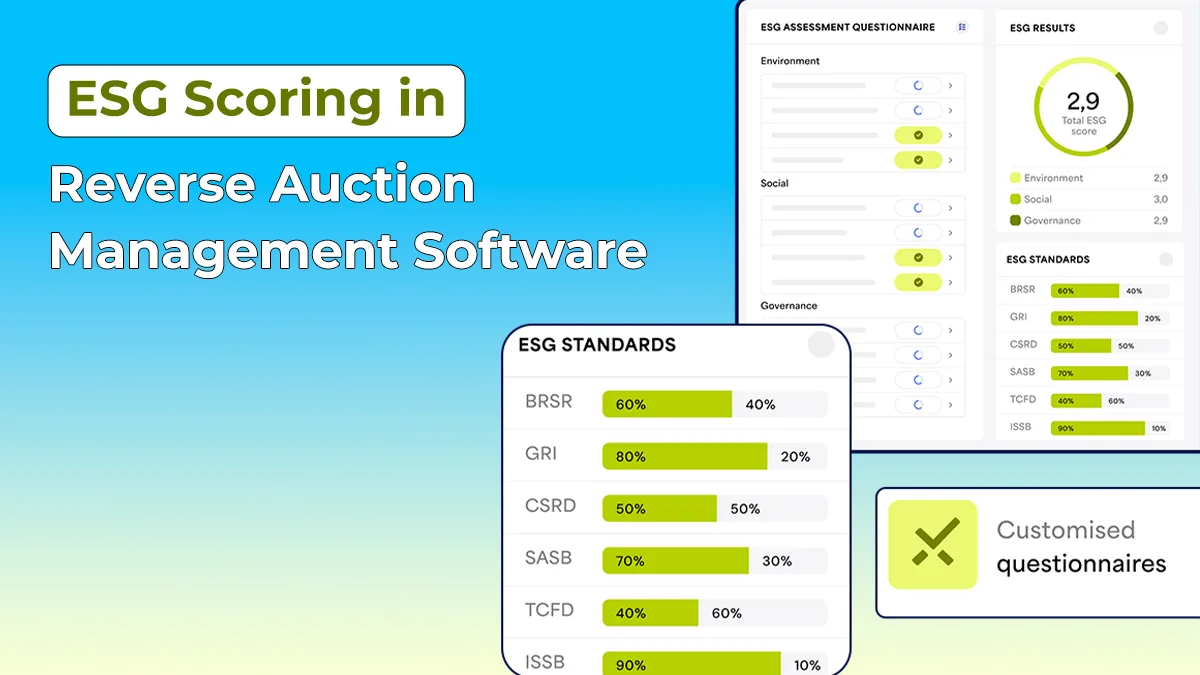
ESG stands for Environmental, Social, and Governance. ESG scoring is an evaluation of suppliers for sustainability, ethics, and compliance. In other words, ESG Scoring involves cost and other aspects, like labor practices, carbon footprint, and supplier transparency, in ranking bids. It can transform auctions from price comparison into value-based decisions. ESG scoring gives a comprehensive picture, and companies can make more informed decisions. An ESG-driven reverse auction system is different than the traditional one. Here is a quick table that compares both these methods.
Factor | Traditional Reverse Auction | ESG-based Reverse Auction |
|---|---|---|
Decision Criteria | Lowest Price | Price and ESG Score |
Supplier Evaluation | Limited | Multidimensional |
Risk Management | Reactive | Proactive |
Compliance | Manual | Built-in |
Long-Term Value | Low | High |
An advanced reverse auction software has embedded ESG. Let’s dig deeper into the effective ways to implement ESG in the reverse auction platform.
How to Implement ESG in Reverse Auction System
Implementation of ESG offers a competitive advantage to modern organizations. Here is a step-by-step understanding of implementing ESG in the reverse auction management system.
Step 1. Define the Criteria
It starts by identifying carbon emissions, ethical sourcing, and supplier diversity. Companies should keep all these aspects under control, as they matter most to their business.
Step 2. Assign Weights to Factors
Let’s face it. All criteria are not equal in ESG. Therefore, companies should define the factors that impact their businesses and their value in terms of price.
Step 3. Integrate ESG into Auction Workflow
This is a crucial step. Here, you need to ensure that your reverse auction system should-
Capture ESG data during onboarding
The onboarding stage starts with collecting structured ESG information from suppliers, including certifications and compliance records. It ensures that every supplier follows reliable ESG criteria continuously from the beginning.
Display ESG scores during bidding
It is essential to show ESG scores alongside pricing data in real time during the auction. It enables the procurement teams to make informed decisions by maintaining a balance between cost and sustainability.
Factor ESG into the final evaluation
This is a final evaluation stage. Here, companies integrate ESG scores into the overall supplier ranking. It is essential to ensure that the selected supplier is capable of delivering economic value and long-term sustainability.
These actions improve the auction workflow over the period.
Step 4. Train Procurement Team
Finally, it is essential to educate teams on ESG importance and align procurement goals. An advanced reverse auction software can encourage data-driven decisions.
In our experience, companies that keep teams in line with their ESG goals can see quicker adoption and better supplier quality over the period. Core industries can leverage the benefits of ESG-enabled reverse auction management software. Let’s go through the real-time use cases.
Real Use Cases of ESG-Powered Reverse Auction Software
Manufacturing and other core industry sectors need to follow ESG regulations rigorously. Here is how an ESG-enabled reverse auction management software can help them meet this requirement.
When a manufacturing company sources raw materials from multiple suppliers, ESG-powered auctions can bring more clarity and control. Price volatility and supplier compliance risks may create uncertainty, especially when companies make cost-based decisions. An ESG-enabled reverse auction solution can go beyond price comparisons and give a complete idea of the supplier’s sustainability and compliance.
It ensures that the suppliers that a manufacturing company chooses remain according to their long-term operational and environmental goals. As a result, they can get a more stable supply chain with reduced risks and more responsible sourcing. Let’s take another example of a global enterprise.
When an MNC operates across different regulated markets, the stakes are higher. It is more complex and time-consuming to manage ESG compliance requirements and maintain supplier transparency across regions. The implementation of an ESG-driven reverse auction platform enables you to automate compliance tracking and standardize supplier evaluation across different regions. It simplifies procurement operations and strengthens governance.
ESG-based reverse auction solutions can help reduce regulatory risks, ensure consistent compliance, and build a more resilient ecosystem for suppliers.
Future of Reverse Auction in Procurement and Business
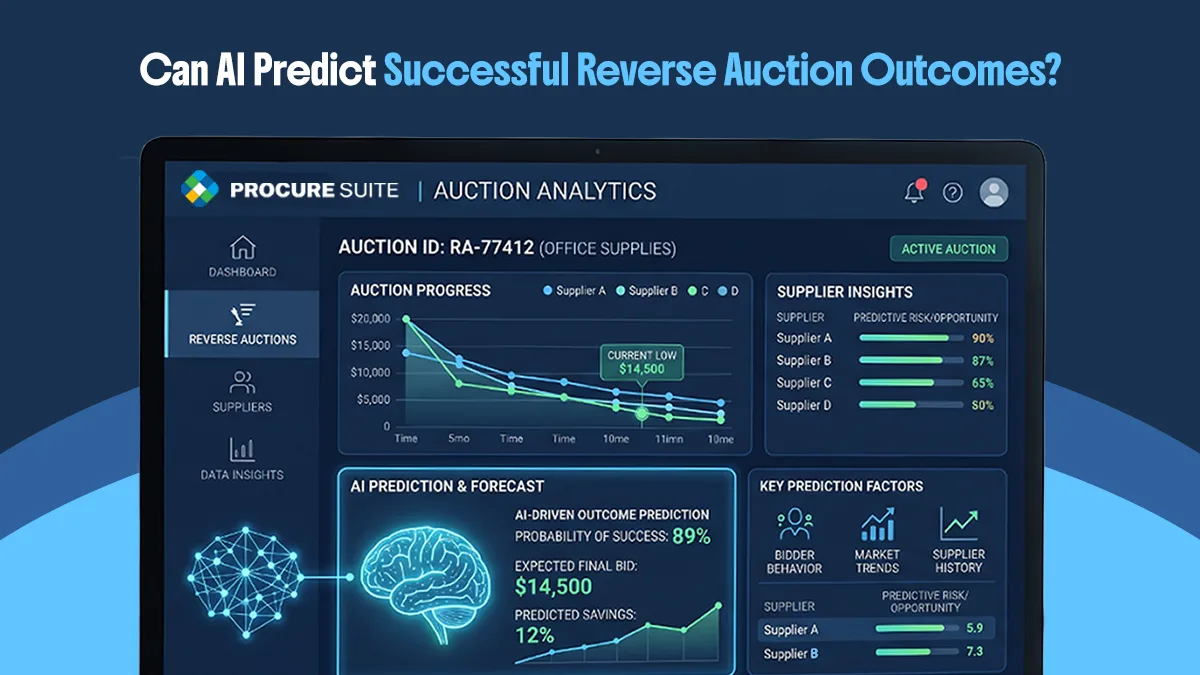
The future of reverse auction is highly promising and getting more accountable. AI-driven ESG scoring will enable systems to evaluate suppliers more accurately over the period. Real-time carbon monitoring will increase the visibility of environmental impacts. We can expect the advent of blockchain in reverse auction process management software. Blockchain will make supplier data more transparent and trustworthy. It will make supplier data tamper-proof.
Predictive risk analysis is another trend to watch in the future. It will enable businesses to anticipate disruptions before they occur. Simply put, reverse auction tools will evolve from digital tools to insight-driven decision systems in the future. This will make businesses control the procurement process more efficiently.
Concluding Lines
ESG scoring in reverse auction process management can make the supply chain resilient and give the necessary environment-related information about suppliers. Companies can achieve cost efficiency and long-term value through an ESG-powered reverse auction in procurement. In other words, ESG reverse caution will make procurement a strategic move. However, it is essential to choose the best online auction software to leverage the advantage of ESG scoring.