Overview
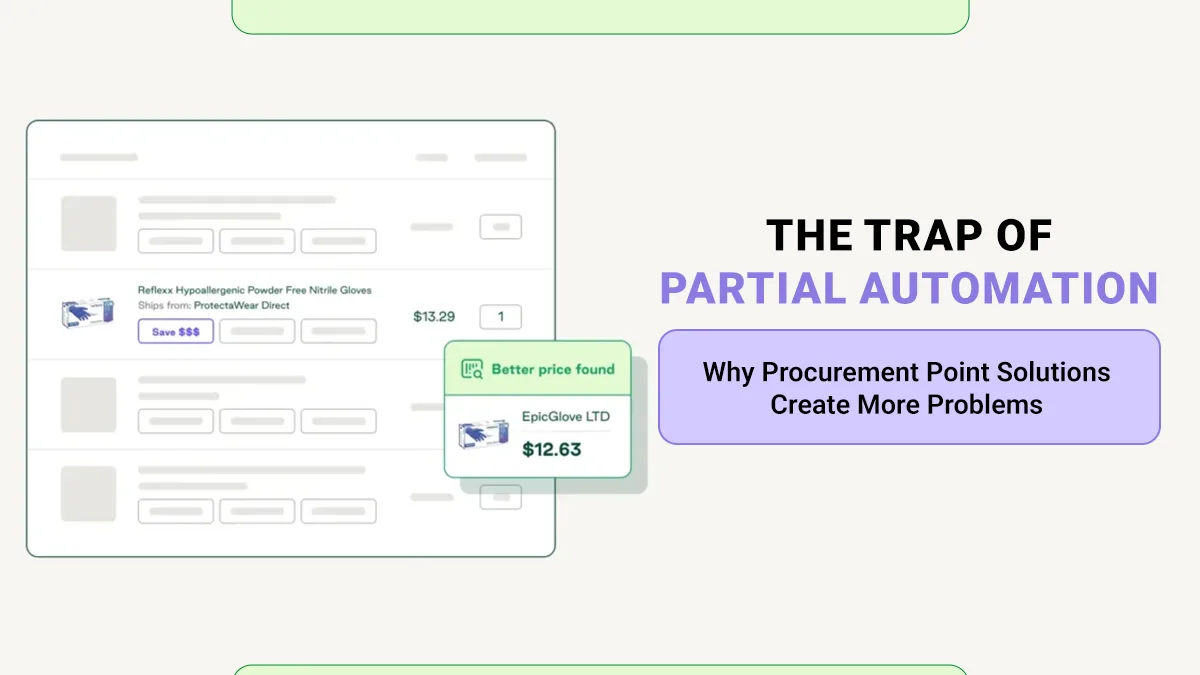
Whether you are a CFO or a VP for supply chain management, the biggest risk you face is partial automation. Automation of different parts of procurement in isolation results in process failure. For example, a sourcing platform can make RFPs faster. A purchasing application can accelerate PO creation. When each of these implementations or point-wise solutions does not share data and workflows, it results in procurement silos, information duplication, and multiple versions of the same supplier. This is a macro business risk of partial automation. Companies face various issues due to it.
These issues lead to operational inefficiencies. When one automated step produces transactions faster than the next step can handle it properly. For example, faster PO generation can increase invoice volumes, and automated supplier onboarding creates more transactions for purchasing teams.
These operational risks are micro issues of partial automation. This blog discusses macro and micro issues related to procurement automation. These issues impact procurement transformation significantly, and therefore, it is important to consider complete automation of the process.
Macro Risk- How Procurement Point Solutions Create Silos
Partial automation brings strategic problems. In this scenario, one system may contain supplier information, and another has sourcing results. A separate contract platform may store negotiated terms, and a procurement application may hold POs. Each system is useful, but collectively they create issues.
1. Multiple Systems, Different Versions of Truth
What if a supplier’s information does exist across four different applications? The legal name differs slightly, payment terms may not have been updated in all locations, and contract values may not match. All such issues can emerge because the company has no connected flow of information.
This leads to more time spent determining the accurate record. This affects more than reporting. If procurement cannot connect supplier, contract, sourcing, and payment information reliably, leadership may fail in making strategic decisions.
This issue leads a CFO to struggle to determine the true financial impact of negotiations. Similarly, a supply chain VP may struggle to identify supplier concentration or performance risks.
2. Less Enterprise Visibility Due to Procurement Silos
A procurement point solution can give excellent visibility into its own process. An invoice platform can tell you the number of processed invoices. But leadership needs to understand the relationship between all the events of a procurement lifecycle.
When data sits in disconnected systems, answering them requires manual effort. End-to-end procurement management software can handle these events with complete automation.
3. Disconnected Tools Increase Technology Complexity
Point solutions create integration complexity. This is because every new application may require connections to existing systems. Those integrations need to handle data mapping, authentication, synchronization, security, updates, and ongoing maintenance.
When applications increase, IT and procurement teams have more relationships to manage. As a result, the organization needs to spend significant resources maintaining its procurement technology stack. Here is the broader equation-
License + integration + implementation + maintenance + data management + training + support + process complexity
A separate solution that looks inexpensive at purchase can become costly when it works across a fragmented architecture. It leads to micro risks.
Micro Risk- How Faster Automation Brings Issues
When the company automates individual steps, the micro problem occurs. In other words, the micro issue is nothing but fragmented architecture.
Imagine a company introduces procurement workflow automation and reduces purchase order creation time from several days to a few hours.
This can certainly benefit the procurement team, but the AP team receives invoices through email. Matching of invoices and products remains partly manual. This results in a slower overall workflow, even though the speed of one activity is increased.
Faster PO Creation Can Create Backlog in AP Invoice
This is an example of the classic partial automation trap.
Before automation, it was-
Requisition → Approval → PO → Invoice
Here, the PO process is slow, so a few invoices reach AP every day.
After automation, it becomes-
Requisition → Faster Approval → Faster PO → More Invoices
AP receives more invoices, and the finance department experiences increased pressure.
This is why purchasing automation should be evaluated alongside the overall capacity.
Faster Supplier Onboarding Increases Downstream Work
Suppose a supplier management solution reduces onboarding time significantly in your organization. It enables you to make more suppliers enter the procurement process quicker. What if supplier validation, contract creation, purchasing configuration, and review are manual processes?
This can lead to chaos and confusion among the procurement teams and suppliers. This is a major reason companies should evaluate procurement process automation across connected activities rather than departmental metrics.
Why Local Efficiency Can Hide Enterprise Inefficiency
Point solutions produce attractive KPIs. A team can report 50 percent faster PO creation, 40 percent faster supplier onboarding, and 30 percent faster RFP processing. The problem here is that none of these figures can prove the efficiency of the procurement lifecycle.
Local automation or optimization does not reveal the situation of procurement efficiency. This is specifically crucial for CFOs and supply chain VPs to know.
A mature procure-to-pay workflow does not end after creating a PO. If you automate only the PO stage, the rest of the stages can determine the outcome. The objective should be, therefore, to determine whether automation improves the whole workflow, and not just a particular stage.
More Procurement Technology for Improved Process
Organizations tend to address a process problem by purchasing more procurement technology. For example, if supplier onboarding is slow, the company purchases supplier management software. If POs are slow, it buys purchasing software.
Every application solves one problem while potentially introducing another connection that needs management. It is better to address an architecture gap than an automation gap. A connected lifecycle that focuses on source to pay automation remains beneficial for modern companies to drive procurement transformation.
How to Build Automation Around Procurement Lifecycle
A robust and advanced procurement management software can connect all the activities instead of treating them at an individual level.
When we say a connected lifecycle, it includes steps from spend analysis to PO creation and supplier onboarding to performance monitoring.
Spend Analysis → Supplier Management → RFI/RFP/RFQ → Evaluation → Negotiation → Contract → Requisition → Approval → PO → Receipt → Invoice → Payment → Supplier Performance
The advantage of this approach is sharing information and decisions from one stage to the next without manual intervention. For example, negotiated supplier pricing established during sourcing should be available when purchasing begins.
This can make automation strategic rather than tactical for your organization.
Role of Procure Suite in More Connected Approach
The core objective of procurement software should be to make the process more connected, and not just automated.
Procure Suite has sourcing, RFP/RFP/RFQ management, auctions, supplier management, purchasing, and other related features in a connected environment.
CFOs can get greater visibility across the procurement process and support stronger control over spend. Supply chain VPs can get help connecting supplier decisions with downstream procurement execution.
Procure Suite increases strategic value by reducing unnecessary handoffs between different procurement activities.
Concluding Remarks
Disconnected procurement tools can create silos, fragmented data, integration complexity, and other issues. Macro and micro hurdles can increase the strategic risk for CFOs and supply chain VPs. Partial automation may lead to problems related to decision-making.
That is why effective procurement automation is essential around the entire lifecycle. Here, the goal should remain to connect sourcing, supplier onboarding, contracting, purchasing, and monitoring on a single platform with minimal friction.
Organizations that evaluate their next procurement software investment should avoid partial automation to stay away from traps.