Overview
RFP (Request for Proposal) selection focuses on comparing suppliers objectively. It helps procurement teams select the proposal that delivers the strongest value. Factors like personal preferences, brand familiarity, previous supplier relationships, and presentation quality can influence this process. These factors can make decisions inconsistent with some bias.
Strong RFP evaluation begins before your procurement team opens the first proposal. Clearly defined requirements, measurable evaluation criteria, a consistent scoring matrix, and procurement governance are necessary for fair evaluation. The supplier evaluation here aims at making structured and evidence-based judgment.
This blog talks about evaluation bias in selecting an RFP and effective ways to reduce it.
Evaluation Bias in RFP Selection- How It Impacts Procurement
When factors unrelated to the actual procurement requirements influence the way of assessing a supplier or proposal, evaluation bias occurs. Bias, however, does not always mean intentional favoritism.
A procurement manager may give more weight to a well-known brand unconsciously. Another evaluator may penalize a supplier because its proposal uses unfamiliar terminology. Here we mention some common forms of procurement bias.
Confirmation Bias
Evaluators look for evidence supporting an initial preference.
Halo Effect
A strong brand reputation influences assessments of criteria.
Recency Bias
Recent experiences with a supplier affect the evaluation.
Price Bias
A lower price is considered to give better value.
Familiarity Bias
Existing or well-known suppliers receive more consideration.
Presentation Bias
Visual design or sales confidence influence technical scoring.
All these biases affect supplier selection and increase procurement risk. They can make the final decision difficult to explain to stakeholders.
Effective Tips to Reduce Evaluation Bias in RFP
Advanced RFP procurement software can play a vital role in reducing evaluation bias. Here are some practical and effective tips to reduce this bias in RFP selection.
Define Evaluation Criteria in Advance
It is the strongest way to reduce bias. Your evaluation criteria should connect to the business requirements directly. You should not include criteria that fail to influence the decision meaningfully. For example, instead of evaluating a software supplier on a vague criterion such as ‘overall solution quality’, it is better to define measurable areas.
This approach is consistent with established source-selection guidance. It emphasizes that evaluation factors should represent proper areas and enable meaningful comparison.
Separate Mandatory Requirements
Some requirements are mandatory, and some of them are useful for comparative analysis. Mixing both of these requirements can create subjectivity. For example, if a supplier supports a particular security standard, the procurement team may treat this as a pass or fail requirement.
This creates a cleaner decision framework:
Mandatory requirements → Eligibility → Scored criteria → Risk assessment → Commercial assessment → Final decision
This structure also helps evaluators avoid awarding points for capabilities that are not useful for differentiating suppliers.
Build a Scoring Matrix
A scoring matrix gives evaluators a common structure for assessing every supplier. Here is a basic matrix with defined standards.
Evaluation Area | Weightage (in percentage) | Evaluation Standard |
Functional fit | 25 | Alignment with defined business requirements |
Technical capability | 20 | Architecture, integration, security, scalability |
Implementation approach | 20 | Methodology, timeline, resources, risk controls |
Supplier experience | 15 | Relevant projects and demonstrated capability |
Support model | 10 | SLAs, service coverage, escalation process |
Commercial value | 10 | Price, TCO, commercial terms |
The exact weighting should depend on the procurement. Here, consistency is the important point.
Evaluate Evidence, and Not Presentation
A sophisticated, elegant proposal can be persuasive but not the strongest one. This is specifically true in complex RFPs where suppliers have experienced proposal terms and sophisticated sales organizations. A visually impressive proposal should not receive extra points unless presentation quality is an explicit functional requirement.
One of the important procurement best practices can be: score what matters to successful contract performance, not what makes a proposal enjoyable to read.
Use Independent Evaluations First
Independent evaluations are more useful than group discussions. This is because when your team conducts group discussions too early, it can create conformity bias. It is, therefore, better to give evaluators the same requirements and scoring standards. They can evaluate independently and give their initial scores with comments. You can compare score variations and discuss significant differences.
Evaluators can revise scores only when they have evidence for the same. Finally, the team can document the rationale for material changes.
Control Biased Information
In some procurement situations, evaluators do not need every piece of information at the same time. Procurement teams can separate evaluation stages in technical evaluation, functional assessment, risk assessment, commercial evaluation, and integrated decision.
This is, however, not about hiding relevant information permanently. The objective is to prevent one factor from degrading another.
Establish Conflict of Interest
Personal or professional relationships can create actual and perceived conflicts. Evaluators should disclose relationships or circumstances that could affect their impartiality before the process begins.
A procurement governance process is necessary for handling additional review or evaluator replacement. This is important for strategic or high-value procurement.
Monitor Score Variance
Score differences can reveal more than disagreement about suppliers. They can reveal weaknesses in the evaluation framework. Large variations trigger discussion rather than automatic averaging.
An average score can hide important disagreements. Procurement leaders should examine the reasoning behind unusual scores. This is specifically necessary when a single evaluator’s rating affects the ranking.
Make Evidence-Based Comparison
Supplier comparison should focus on how well each of them satisfies the predefined requirements. Your procurement team should give a preference to evidence-based, defensible evaluation.
A strong supplier assessment should connect every major conclusion to evidence. This evidence can be contained in the proposal, clarification response, reference check, or other approved source.
Use Technology for Auditing
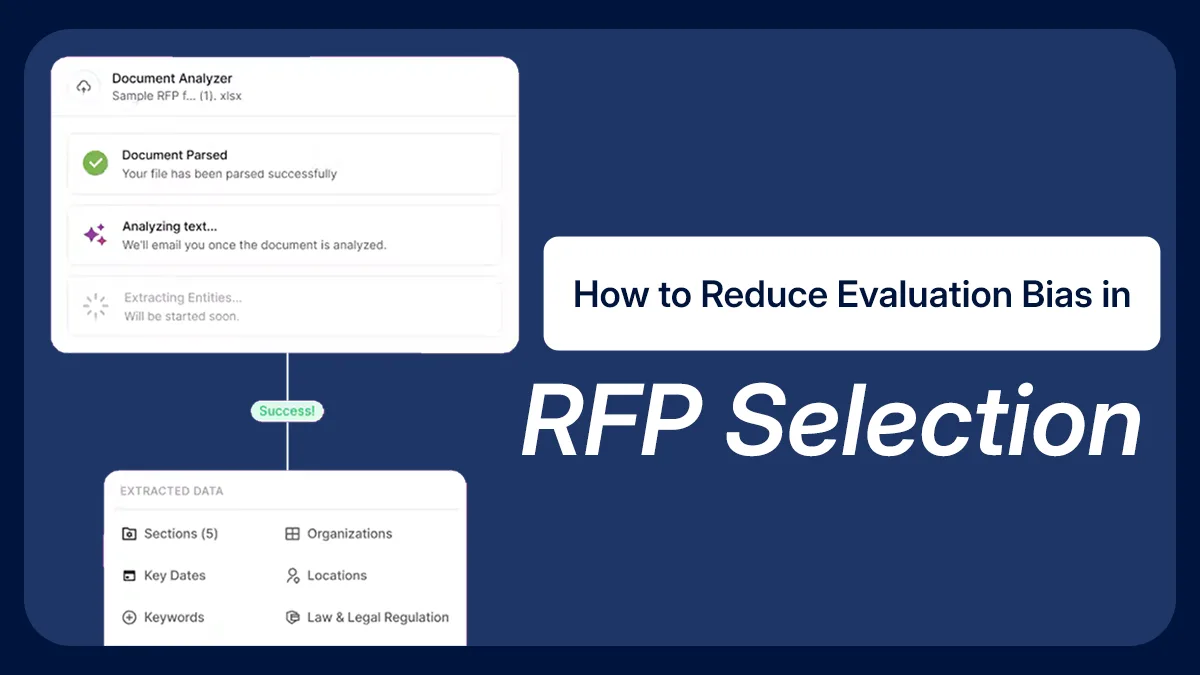
Manual spreadsheets can support smaller RFPs, but complex evaluations become harder to control with them. When multiple stakeholders, suppliers, criteria, and review stages are involved, it is necessary to consider RFP procurement software.
As a structured platform, it helps procurement teams standardize evaluation criteria, proposal scoring, approval workflows, and supplier response collection. Companies can use RFP solutions for proposal scoring, approval workflows, evaluation history, audit records, and procurement reporting.
An RFP management solution enables organizations to manage frequent or complex sourcing events. It supports stronger procurement transparency and compliance.
Apart from these practices, it is important to apply procurement governance to deal with exceptions and score changes. A controlled procurement process and a structured decision framework can help companies reduce RFP bias significantly.
Why Reducing Bias Matters Beyond the RFP
Bias in RFP evaluation may bring consequences in the long term. Choosing the wrong supplier leads to higher procurement costs, contract disputes, poor service levels, and difficulties in transitions. The wrong supplier offers poor service levels and delays in implementation.
As a result, your company may face the risks related to compliance exposures and reduced stakeholder confidence.
How to Build a Fairer RFP Evaluation Process
Reducing evaluation bias is a huge challenge for process design. The most effective procurement teams do not rely only on evaluators to remain perfectly objective every time. These teams can create a system where objective evaluation is the default.
Finally, teams should define evaluation criteria, using a consistent scoring matrix, requiring evidence for scores, and encouraging independent evaluation.
A robust RFP management solution such as Procure Suite can support this structured approach. It brings RFP activities, supplier responses, evaluation workflows, and procurement records into a centralized environment. Procure Suite makes the procurement process more consistent, transparent, and easier to manage.