Introduction
Every time, no lengthy sourcing exercise is necessary. You can simply ask qualified suppliers to submit prices for standardized products or clearly defined services. This can be the fastest and most practical way to accomplish the purchase process. Some goods or services require a simple quotation, whereas others require a more structured sourcing process. It is essential to know when a quotation is enough, and this blog talks about it.
An RFQ (Request for Quotation) is highly effective in two circumstances. One, the buyer knows exactly the required product or service, and two, suppliers can compete on measurable commercial terms. When specifications are not clear, or when suppliers need to propose different approaches, it is better to go beyond an RFQ. If the purchase involves particular risk, then relying on an RFQ can also lead to issues in sourcing decisions.
The right approach is to keep every purchase straightforward. You need to match the procurement method with the complexity, risk, and strategic importance of your requirement. A well-defined RFQ process can improve efficiency for routine purchases. It is, however, necessary to mention that when evaluation involves several factors, it is better to opt for more comprehensive methods.
Scope of RFQ as the Right Procurement Method
As a formal procurement document, a Request for Quotation (RFQ) can provide supplier pricing and other commercial information to your company. It includes product or service specifications, necessary quantities, delivery requirements, commercial terms, payment conditions, and submission deadlines.
When there is a well-defined requirement in the buyer’s mind, and suppliers compete to satisfy it under particular conditions, the RFQ method is applicable. The firm should choose RFQ where the following circumstances exist.
Clearly Defined Specifications
Where the organization has knowledge about the product, its exact quantity and specifications, the suppliers would be able to provide similar quotations.
Price is the Key Factor
Where the suppliers have similar products/services to offer, competitive quoting/pricing is a factor that can help procurement teams accept the most attractive option.
Multiple Suppliers for Same Requirement
When multiple qualified suppliers can provide substantially comparable products or services, it is better to evaluate total cost, delivery time, payment terms, warranty, and other factors.
RFQ is beneficial for efficient and transparent supplier comparison. It is interesting to compare RFQ with other complex sourcing methods like RFI and RFP.
RFQ vs Other Complex Sourcing Methods
Price comparison is not enough to meet every procurement requirement. Procurement teams need to understand the differences between different methods when moving from standardized purchases to complex or strategic requirements. Here is a quick table showing different situations and recommended sourcing methods.
Situation of Procurement | Recommended Method or Approach |
Standard product with fixed specifications | RFQ |
Known quantity and delivery requirements | RFQ |
Multiple suppliers offer equivalent products | RFQ |
Requirement needs supplier expertise | RFP or Structured Sourcing |
Specifications are still being developed | RFI |
Solution quality and methodology matter significantly | RFP |
Highly strategic or high-risk purchase | Comprehensive Strategic Sourcing |
Sole supplier or highly specialized requirement | Alternative Sourcing Approach |
It is fair to say that the goal here is not to replace RFQs with more complicated processes. This table is useful to choose the most relevant and simplest method to make a reliable procurement decision.
How to Evaluate Whether an RFQ is Enough
Procurement teams can assess the requirement by finding answers to some simple questions. For example, if the question is: Is the requirement clearly defined? If yes, an RFQ is preferable. If the question is: Can multiple suppliers provide substantially equivalent solutions? If yes, it is better to get competitive quotations. Similarly, if technical or strategic differences between suppliers are limited and the failure of any supplier is not risky, an RFQ should be the option.
Similarly, if several answers to the above questions are ‘no’, procurement teams should consider the most suitable sourcing approach.
Points to Consider before Choosing an RFQ
Procurement professionals can consider the following points before choosing an RFQ as a preferred process:
Clarity of Requirements: If specifications, quantities, and delivery expectations are defined clearly.
Availability of Suppliers: If enough qualified suppliers are available for meeting the requirements.
Comparability of Price: If your company can compare quotations on an equivalent basis.
Risks for Business: If supplier failure does not affect business operations significantly.
Needs for Compliance: If regulatory, contractual, or governance-related requirements are not involved.
Other Criteria: If the final decision is made using predefined commercial and quality criteria.
Finally, it is important to check whether the purchase contributes to a long-term business objective. All these considerations help your company’s procurement teams avoid any mistakes. They can stay away from making a simple purchase unnecessarily complicated or using an RFQ for complex requirements.
How to Build an Effective RFQ Process
A poorly designed RFQ can result in incomplete quotations, inconsistent pricing, and unnecessary back-and-forth with suppliers. It is, therefore, necessary to make a well-designed RFQ that creates a clear platform for comparison. Such an RFQ gives information about delivery location, technical specifications, quantity, warranty expectations, etc. It helps procurement teams move from requirement to supplier selection with fewer delays.
Here are the key stages for ensuring an effective RFQ process:
Define the requirement
Identify qualified suppliers
Prepare standardized documents
Invite suppliers to submit quotations
Clarify questions and requirements
Collect and validate responses
Compare commercial and non-commercial terms
Select the right supplier
Obtain necessary approvals
Convert the decision into a purchase order
You can standardize these steps to increase consistency and effectiveness of an RFQ process. A clear RFQ leads to a fruitful procurement process.
Request for Quotation Software to Reduce Manual Work
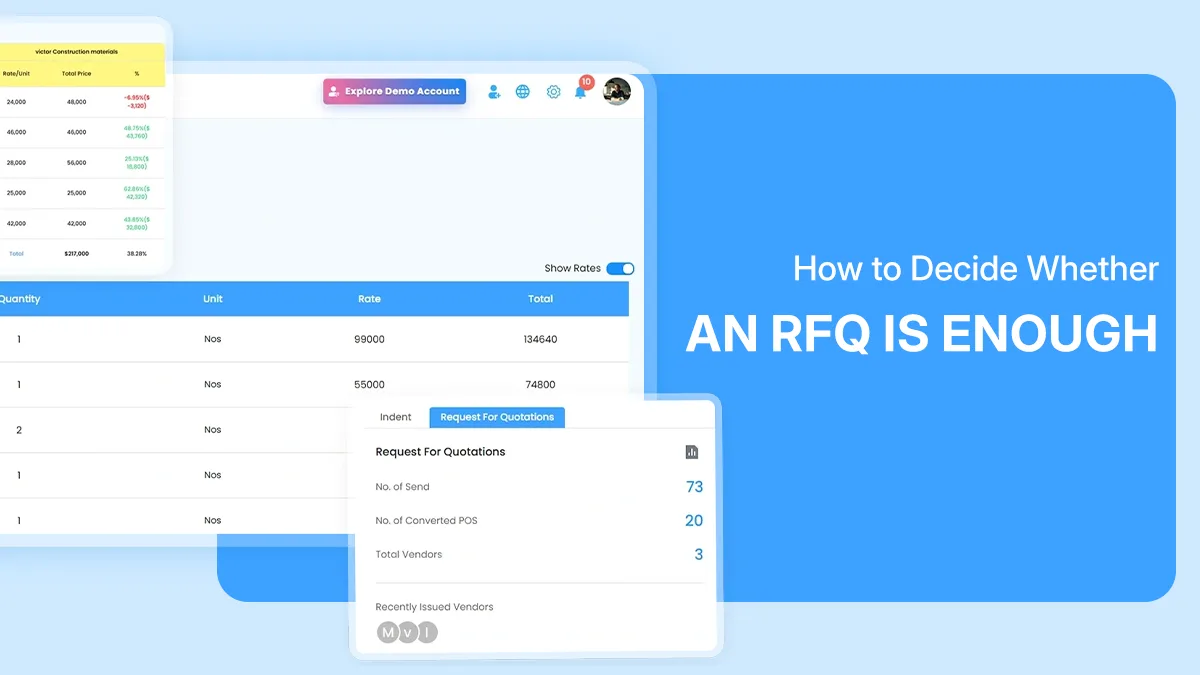
Technology evolves to assist procurement teams in managing a large number of RFQs. Custom request for quotation software can automate several repetitive activities related to sourcing and quotation management. It allows the procurement department to make RFQs, invite suppliers, receive replies, evaluate bids, and incorporate the approved results into the procurement process. Such a connected procurement workflow can handle various tasks without human intervention.
Using RFQ software will allow you to automate the process and avoid common mistakes. Some of these mistakes include a lack of responses from suppliers, duplication of information, missing attachments in emails, and delayed approvals. It digitizes an existing procurement process to make the entire sourcing workflow more structured. Your procurement teams can leverage the benefits of an RFQ solution by following some best practices.
RFQ Best Practices for Procurement Teams
Here we mention some best practices that can help your company improve RFQ outcomes.
Standardize RFQ Templates: Consistent and standardized templates for similar categories are useful for giving comparable requirements to suppliers.
Set Clear Deadlines: Realistic submission deadlines and effective communication with all participating suppliers are essential.
Limit Irrelevant Suppliers: inviting every available supplier is not a good practice because it increases administrative work without improving competition.
Document Every Criteria: You should record why a supplier was selected instead of relying solely on the final quoted price of that supplier.
Monitor Supplier Performance: Actual delivery and performance monitoring of suppliers is essential with the RFQ for making sourcing decisions in the future.
An advanced RFI-RFP-RFQ solution, Procure Suite, can streamline the procurement process by offering the necessary features.
How Procure Suite Supports RFQ Management
Procure Suite offers a connected procurement environment to organizations worldwide. As a centralized platform, it makes it easier for the team to handle supplier invitations, quotations, comparisons, and other tasks associated with the process of purchasing based on RFQs. The solution facilitates better management of RFQs while offering greater visibility throughout the procurement process. Procure Suite also supports broader procurement requirements where RFQ is just one of them.
Organizations can standardize the purchasing process with a more structured approach, particularly when requirements are complex. This leads to a process that is much more manageable and scalable.
Conclusion
An RFQ is an efficient method, especially when the requirement is clear, suppliers can provide comparable products or services, and price is a crucial factor. If a requirement involves significant complexity, strategic importance, or business risk, a broader sourcing approach is essential. The objective should not be to make every purchase process more complicated. Instead, it is better to create the right procurement process as per the situation.
Digital tools like request for quotation software enable organizations to leverage the benefits of RFQ by connecting quotation management with the broader procurement workflow. Procurement teams can make faster decisions while maintaining better visibility and control using an RFQ solution.