Introduction
An effective RFP will enable a systematic approach to assessing suppliers’ capabilities, solutions offered, risks, apart from pricing.
Many procurement groups tend to develop RFPs based on just simple parameters such as specifications, deadlines, and pricing. With important queries missing, procurement groups find themselves with supplier bids that cannot be compared easily, making the process of decision-making much longer.
The good RFP Queries ensure that procurement groups do not fall into the above trap. Procurement groups are guaranteed to get all the information needed to make objective decisions.
This blog explores the key queries that procurement groups need to include in their RFP. It also explains how RFP-RFI-RFQ software can help procurement groups to develop an efficient and strategic procurement process.
Why the Right RFP Questions Matter
Every RFP should ultimately help answer one question: Which supplier can deliver the best overall outcome for our organization?
Answering this question requires more than comparing prices. Procurement teams need to understand whether suppliers can meet business requirements, deliver on time, manage risks, provide reliable support, and scale as needs change.
Strong RFP questions create consistency across supplier responses. When every supplier responds to the same requirements and evaluation criteria, procurement teams can conduct a more objective supplier Evaluation and make supplier comparisons easier.
An effective RFP should therefore cover:
Business and technical requirements
Supplier qualifications and experience
Proposed solution and implementation
Pricing and total cost
Risk, security, and compliance
Service levels and performance
Scalability and long-term value
Questions Every RFP Must Include
12 questions should be part of every RFP document. Let’s have a detailed look.
1. What Exactly Does the Organization Need?
The first question that an RFP must always address is: What are we purchasing and what will be the business result of our procurement?
Suppliers cannot create useful proposals unless there is clarity in terms of the requirements of the organization. The requirements may cover functional specifications, technical requirements, services, delivery, compliance, integration, and reporting.
Mandatory requirements should not be confused with preferred capabilities; it is crucial to identify which aspects of the requirements are non-negotiable.
Defining the procurement requirements is the starting point for all procurement. Clear procurement requirements allow the organization to determine if it is qualified to take part in the process. In the end, clear scoping results in more relevant proposals and reduces unnecessary clarifications at the sourcing event.
2. Has the Supplier Got Any Relevant Experience?
The ability of a supplier to meet requirements needs proof. Therefore, in the RFP process, one should consider asking the suppliers about their relevant experience instead of just expertise.
A procurement team can make the suppliers tell about similar projects and clients, years of experience, industry expertise, as well as achievements for comparable organizations.
Customer references and case studies can also help with the supplier evaluation process.
For instance, the supplier has much experience providing a certain solution however, that experience does not apply to a company with many regulatory requirements and a big international presence.
The relevant experience of the supplier thus needs to be considered not only in terms of years of activity of the supplier.
3. How Does the Supplier Plan to Provide the Offered Solution?
A good RFP will force suppliers to describe how they plan to do this rather than merely confirming that they can offer the required goods or services.
The suppliers will need to specify:
Delivery methodology they plan to use
Implementation milestones
Supplier and customer resources that will be needed
Technical requirements
Assumptions
Support after implementation
It is especially important for more complicated projects since two suppliers may claim to have the same capabilities, but use completely different methodologies.
4. How Much Will This Solution Really Cost?
Cost is arguably one of the most critical criteria within an RFP, but the evaluation team must avoid relying only on the first quoted price when making comparisons among suppliers.
The RFP should outline a standard framework for costing that will take into account implementation costs, recurrent charges, licensing, maintenance, support, training, integration, and any other relevant cost factors.
Suppliers should also be made to explain the assumptions that underpin their cost estimates. It will make it easy to assess the cost of all solutions and highlight hidden costs in the first quoted prices.
While a supplier with the lowest purchase cost may prove to be costlier in the long run due to various reasons such as customization and other services, comprehensive cost evaluation will facilitate better Strategic Sourcing.
5. What are the Service Commitments of the Supplier?
Performance of the supplier post-award is equally important as the selection process.
These expectations can be made as part of the request for proposal and then used to form part of the contract or service level agreement.
Instead of merely asking if the supplier offers support, procurement professionals need to ask questions including the following:
What are your service levels like?
What is your speed of acknowledging and addressing issues?
How are you measuring supplier performance?
What kind of reporting will the buyer get?
What are the consequences of failing to meet the agreed service levels?
This ensures accountability from the start of the supplier relationship.
6. What Are the Risks and Assumptions That Need to Be Known?
All supplier proposals will have some risks and assumptions attached to them. The most effective RFPs ask suppliers to reveal them.
The factors that could influence the implementation, delivery, cost, quality of service, and general success of the project need to be revealed.
For instance, suppliers could be dependent on receiving certain information from the client by a particular deadline or have access to technical capabilities of the company. Not revealing such risks may result in problems in the future.
Asking suppliers to reveal their risks shows the organization's seriousness about a transparent evaluation process. It also gives a chance to procurement officers to evaluate not only promises but risks of all proposals.
7. Is the Supplier Able to Meet the Security and Compliance Requirements?
The security and compliance aspects need to be considered when there is any kind of procurement of sensitive data, regulated operations, technology, and/or third-party access.
Depending upon the nature of the procurement, an RFP will have to consider the following items:
Data protection and privacy
Compliance with the regulations
Information security controls
Certifications and standards
Incident handling
Business continuity planning
Data management
Third-party or sub-contractor access
This way, it would avoid the risk of choosing a supplier which would fail to meet the compliance, security and/or legal requirements in the future.
It also makes sure that procurement is carried out in cooperation with legal, IT, security, finance and other relevant stakeholders.
8. Is the Supplier Scalable with the Organization?
In the planning for procurement, consideration should be given to future demands and not just the existing demands.
A supplier may be able to satisfy existing demands but may find it difficult to cater for the demands when the organization ventures into new markets or when the number of users rises, or there is an increase in demand for other services.
The RFP should therefore seek to know how scalable the solution from the supplier is and any constraints associated with such scalability.
It is important to note how the cost will vary based on volume and whether additional infrastructure will be required.
9. What Is the Implementation Timeline?
A supplier's proposed implementation timeline should be realistic, detailed, and measurable.
Rather than accepting a simple statement such as "implementation will take three months," the RFP should ask suppliers to explain the major phases, milestones, dependencies, and customer responsibilities.
For complex procurements, the proposal should explain how the supplier will manage:
Planning and discovery
Configuration or development
Testing
Training
Deployment
Post-launch support
This allows procurement teams to identify unrealistic promises and understand the internal resources required from their own organization.
A clear implementation plan also becomes an important part of the final supplier evaluation.
10. How Will the Proposals Be Assessed?
The evaluation question is one of the most critical ones in an RFP, posed not to respondents but to the procurement team itself:
How will we assess the proposals to select the best one?
The evaluation criteria need to be identified before the proposals are assessed. They may include technical suitability, supplier’s experience, solution quality, implementation approach, services offered, risk, compliance, commercial benefit, and strategic fit.
The importance of price needs to be determined, and then considered as such – not being made the main factor automatically.
Bid evaluation process helps to make the decision more objective and less subjective.
11. What Should the Supplier Do About the Exceptions?
Certainly, no supplier is going to satisfy every requirement in full measure. Rather than forcing suppliers to give either yes or no answers, the request for proposal should have a provision for identifying exceptions.
The supplier should list all requirements he is unable to fully meet, along with any other required customizations, the associated extra costs, and suggested alternatives.
The benefit of such information is that it highlights all those differences which might be unnoticed during the evaluation process.
12. How Should Success Be Defined Post-Supplier Selection?
The RFP process does not end with supplier selection. Procurement teams must also identify how success will be defined post-contract awarding.
The measures that may be used to determine success depending on the type of project include:
Cost reduction
Service level achievement
Quality and delivery
User or customer satisfaction
Compliance
Efficiency
ROI
Innovation and continuous improvement
Identification of these measures during the sourcing process ensures greater alignment of the procurement with corporate strategy.
It also makes management of the performance of suppliers post-contract award easier.
Creating a More Effective Request For Proposal Template
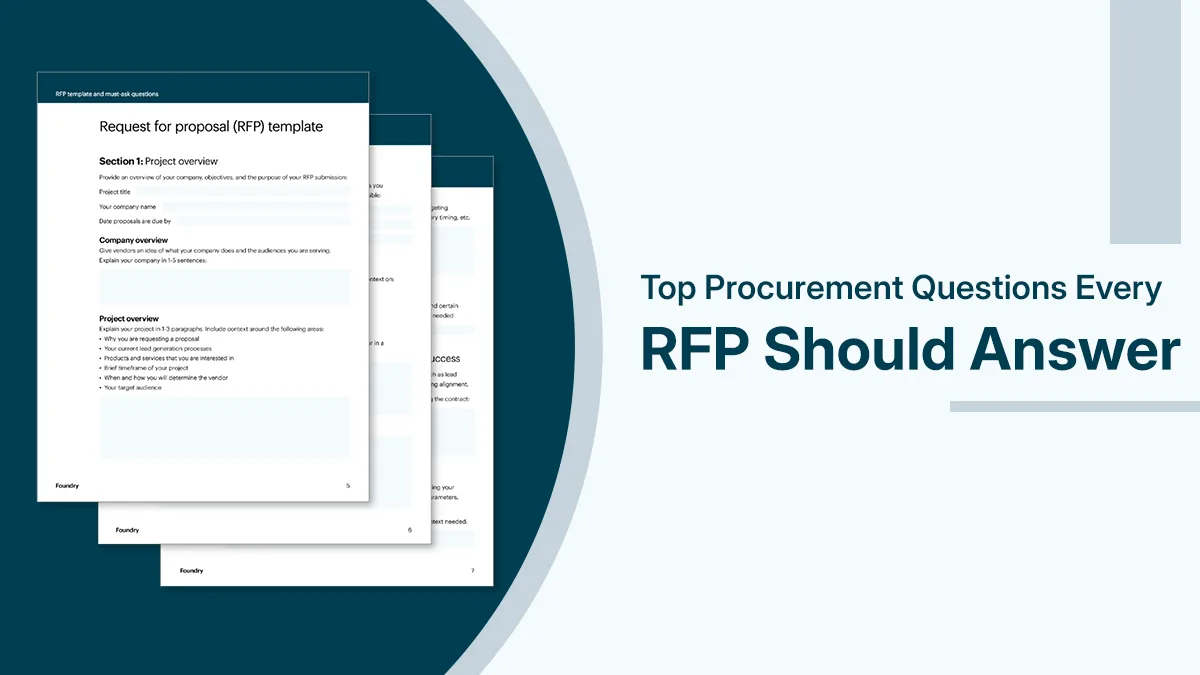
While maintaining flexibility for teams, an RFP Template may contribute to standardization within the procurement process.
Such a template usually starts from the background and the goals of the project, and then it includes supplier information, procurement specifications, solution, implementation method, business answer, requirements to be complied with, and criteria for evaluation.
Also, it should contain clear descriptions of submission guidelines, dates and deadlines, communication procedures, and further steps in the procurement process.
Standardization can be called one of the procurement best practices, since it saves time and makes it easier to compare answers from suppliers.
At the same time, templates should not become too formal. A strategic procurement team should tailor its questions according to the category of goods or services, market of suppliers, business goals, and risks.
How RFP-RFI-RFQ Software Helps with Better Procurement Practices
Manual management of RFPs may turn into an overwhelming experience especially when there are a number of sourcing activities, many suppliers, and large amounts of information involved.
Advanced RFP-RFI-RFQ software may help in automating many of these processes. The team responsible for procurement may set up standard forms and templates, send out requests, communicate with suppliers, gather responses, evaluate responses, and document the entire process using one tool.
Furthermore, the use of technology makes collaboration between procurement staff and other relevant parties easier. It allows evaluators to rely on a common set of criteria and access centralized information.
This is especially beneficial for companies trying to have more control and uniformity of the process.
Technology does not eliminate the need for procurement expertise; rather, it enhances it.
Conclusion
An efficient RFP is far from just another request for supplier submissions. Instead, it should be a framework for decision-making, allowing organizations to evaluate the available choices, compare suppliers objectively, assess risks, and choose the best partner.
The most valuable RFP Questions cover all important topics that need attention along the entire process of procurement – requirements, supplier expertise, solution suitability, pricing, implementation, services, risks, compliance, scalability, and performance.
When such RFP Questions are used along with an efficient RFP Template, objective supplier Evaluation, proper procurement governance, and sourcing strategy, the effectiveness of decisions increases.
Organizations that deal with complex or volumetric sourcing processes may even use RFP-RFI-RFQ software to improve the efficiency of creation, communication, submission, and assessment of requests and proposals.
All in all, efficient procurement starts with good questions. The idea is not to make the RFP longer, but to make each question meaningful. By asking suppliers about the necessary information, procurement teams will make their way to effective selection, cooperation, and business value.