Overview
Modernizing enterprise procurement involves complex technical dependencies, ranging from core ERP schemas and financial data flows to identity governance and security access models. For large organizations, attempting to replace an established ERP simply to upgrade procurement workflows introduces massive operational risk, ballooning budgets, and prolonged business disruption.
Therefore, advanced procurement software adds a modular layer around the existing systems. As a result, enterprises can get specialized capabilities through APIs and integrations instead of replacing legacy ERP systems.
This blog talks about the impact of integrating a procurement platform and how its composable architecture can act as a solution. Let’s start with the problem with the rip-and-replace procurement approach.
How Rip-and-Replace Procurement Creates Problems
A rip-and-replace approach assumes that modernization needs replacing the existing stack. For large enterprises, this approach is about migrating data, rebuilding integrations, changing workflows, and coordinating multiple business units before implementing the new environment.
On the other hand, procurement rarely operates independently. It interacts with finance, inventory, suppliers, accounts payable, and logistics. Replacing its technology can create dependencies across the enterprise. Modular procurement gives an answer to this problem.
This approach introduces the capabilities that procurement teams need through a composable architecture.
Scope of Composable Procurement Architecture as a Solution
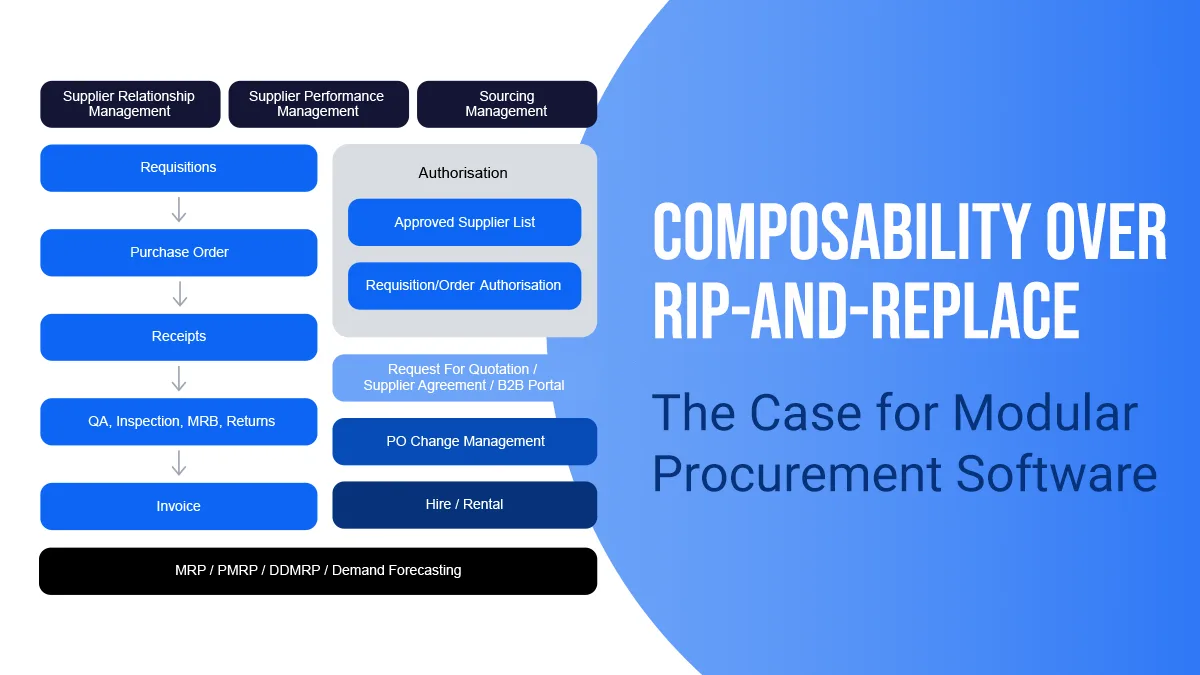
A composable approach treats procurement capabilities as connected components. This approach lets you add or improve the procurement capabilities you need within the existing architecture.
Enterprises can modernize the following with the API-first procurement model:
Sourcing and RFx workflows
Supplier management
Purchase requisitions
Approvals
Contract processes
Spend analysis
Purchase-to-payment workflows
These capabilities do not require replacing the organization’s existing ERP system. An API-first procurement model assists the layer in exchanging relevant information with existing enterprise systems. The ERP can handle core digital or financial records.
On the other hand, the procurement platform offers specialized workflows for this process. As a result, companies can leverage the benefits of reduced friction and an incremental modernization strategy.
API-First Procurement to Reduce Integration Friction
As the name suggests, API remains at the centre of this strategy. A procurement API enables applications to exchange structured information without requiring every system to be rebuilt. This is specifically beneficial for enterprise IT because the existing technology landscape is not uniform.
Every company has an ERP, CRM, supplier databases, data warehouses, identity systems, and custom applications. All these components operate simultaneously. A modern procurement integration strategy should accommodate that reality.
As per the API-first approach, APIs allow relevant information to move between procurement applications and existing systems. Let’s understand it through an ERP example-
ERP → Procurement Layer → Supplier / Procurement Workflow → ERP
Here, the procurement layer can manage specialized purchasing activity while passing the necessary information back to the proper systems. This can reduce the need for a single technology replacement to solve different procurement problems.
Top ERP Environment Integration in Procurement
Your organization may have years of financial data, customized workflows, integrations, and user processes built around advanced ERP systems. Some noteworthy ERP systems include SAP, Oracle, and Microsoft Dynamics. A modular procurement platform sits alongside any of these ERP systems.
Rather than rendering your ERP obsolete, a modular procurement architecture elevates it, serving as a specialized agility layer that preserves core financial integrity while delivering modern user experiences. Here is how a modular procurement strategy supports different ERP systems.
SAP Procurement Integration
Organizations that operate SAP may highly depend on it for financial, material, and operational processes. SAP procurement integration enables them to exchange relevant purchasing information with the existing environment. This integration helps companies avoid replacing SAP ERP.
Oracle Procurement Integration
Enterprises that use Oracle may want to preserve existing processes while improving procurement experiences or specialized sourcing capabilities. Oracle procurement integration offers a pathway for connecting workflows with established enterprise data and processes.
Microsoft Dynamics Procurement
Microsoft Dynamics is another robust and popular ERP ecosystem. Companies that use MS Dynamics may have procurement requirements that extend beyond the current functionality. Microsoft Dynamics procurement can benefit from an integration-led modernization approach.
The ERP integration with procurement depends on several aspects, including APIs, configuration of the existing system, security model, and business requirements. This modernization approach has nothing to do with replacement of legacy ERP.
Procurement Modernization and Integration Strategy
A common mistake during procurement system integration is that companies select applications first and consider integration later. Organizations should consider the procurement integration strategy in the beginning. They can find the answers to the following questions-
Where are POs created and stored?
Which system remains the financial system of record?
How are approvals authenticated?
How are API permissions governed?
How will integrations be monitored?
What data needs to be synchronized in real time?
How are errors detected and retried?
Answering these questions in the beginning can help companies prevent a new procurement application from becoming an isolated system.
Role of Procure Suite as a Composable Procurement Layer
Procure Suite enables enterprises to modernize procurement processes without replacing the existing systems unnecessarily. As a modular layer, Procure Suite supports workflows by integrating with the company’s broader procurement technology stack.
Procure Suite does not promote or force an enterprise to abandon legacy ERP. Instead, it offers advanced procurement-related capabilities that work alongside existing enterprise systems. This approach is relevant especially when an organization has implemented SAP, Oracle, MS Dynamics, or another ERP environment.
The objective here is to establish procurement orchestration rather than creating another obsolete application. CIOs and CTOs can consider procurement modernization as an architecture and integration exercise without replacing their existing ERPs.
How to Evaluate ERP Procurement Software
IT teams and management should consider the following factors when evaluating ERP procurement software:
Integration Flexibility: You may check if the procurement platform integrates with existing ERP, identity, data, and business systems.
Modular Deployment: Management can find out the possibility of implementing the procurement functionality gradually.
Data Ownership: You must identify who owns particular data objects and how synchronization occurs between them.
Security & Governance: You must evaluate the security of the procurement software through authentication, authorization, encryption, and auditability.
It is also necessary to ensure that the architecture is scalable. It means that it will allow you to deal with a growing volume of transactions and number of suppliers in different business units.
With proper software, you can implement and maintain the procurement orchestration process. An effective orchestration process can coordinate workflows across different systems. It allows every application to perform its specific role. The ERP continues to support core enterprise processes.
Concluding Remarks
Enterprise procurement modernization does not require rebuilding the foundation every time. Procurement teams that operate on established ERP environments like SAP and Oracle should define which capabilities need modernization. A modular, API-first approach makes it possible for the company.
Procurement integration assists CIOs, CTOs, and enterprise architects in adding modern capabilities while maintaining their existing ERP investment. This incremental path can improve procurement and avoid turning a transformation into a replacement process.
It is, however, necessary to choose the right procurement technology stack that is highly capable, flexible, and adaptable.