Overview
The selection of a sourcing strategy can directly affect procurement results. In some cases, a sourcing team is required to collect information from suppliers, compare proposals, ask for prices, and organize a competitive environment. All these situations require different approaches like RFI, RFP, RFQ, and reverse auctions.
Although these methods are usually considered together, they fulfill various functions in the procurement process. Selecting an inappropriate method may result in a poor supplier response, incorrect comparison, additional work, or missed cost savings.
It is necessary to know the difference between RFI vs RFP, RFP vs RFQ, and reverse auction.
Overview of RFI, RFP, RFQ, and Reverse Auction
Prior to selecting the method of sourcing, it is necessary to understand the purpose of each.
Request for Information (RFI)
The RFI is used when the procurement team requires specific data before starting the procurement process. It is suitable when a company has identified a business challenge that needs a solution. However, it may not have a clear idea of the suppliers, technologies, or products needed to address this challenge.
The RFI process provides an opportunity to collect information from suppliers without requesting a commercial proposal.
An RFI is more focused on gathering information and market discovery than immediate supplier selection.
Request for Proposal (RFP)
An RFP is used when the organization has a defined requirement but wants to identify how suppliers can fulfill it.
Unlike an RFI, an RFP typically asks suppliers to provide detailed information about their
Proposed solution
Capabilities
Implementation approach
Pricing
Timelines
Other relevant factors
An RFP works well when the buying decision involves multiple evaluation criteria. Price can be important, but it cannot be the only factor for choosing a reliable supplier.
For instance, when choosing a partner to implement software, the following factors might be considered:
Technical expertise
Experience
Security
Implementation approach
Service level
Total cost
The RFP becomes an important tool for strategic sourcing.
Request for Quotation (RFQ)
An RFQ focuses on price. It is best used when the business knows what it wants to buy and expects the suppliers to offer the same prices. It is effective when the business wants to purchase standardized products/services where the specifications, quantities, qualities, and other details are clear.
If a business is looking to buy 10,000 components with detailed specifications, an RFQ can be used to get price quotations from potential suppliers. The major distinction between RFP and RFQ is that RFP considers the overall proposal, while RFQ focuses on price quotation.
Reverse Auction
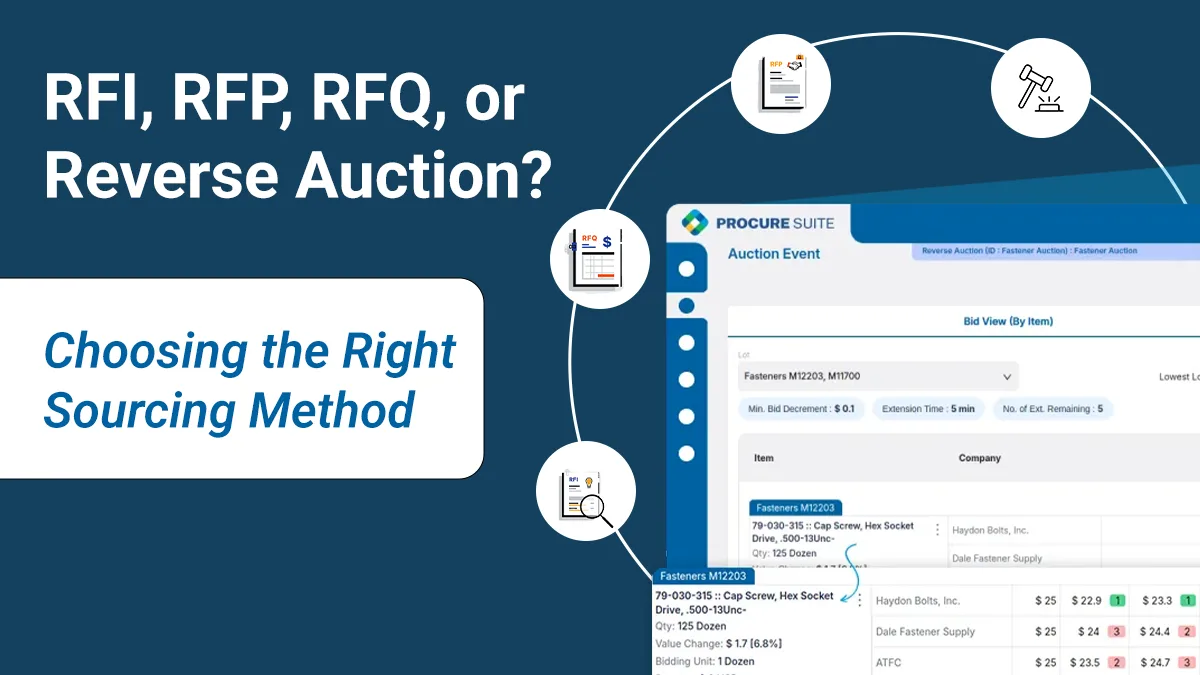
The reverse auction process involves creating a competitive atmosphere where suppliers compete by offering progressively lower prices. It is different from the forward auction process. In a forward auction, bidders make a higher offer. In a reverse auction, suppliers bid for the services of the buyer by lowering their prices.
Reverse auctioning is useful when a business wants to purchase standardized products and the specifications are clear and can be fulfilled by several suppliers.
Price alone cannot be the only evaluation criterion. Criteria such as quality and reliability must also be considered.
RFI vs RFP: The Difference
The key distinction between RFI and RFP lies in the stage of the procurement lifecycle.
An RFI is used in the early stage when the procurement team needs information. An RFP is used in the next stage when defined solutions are required.
It could be explained as follows:
RFI = "What solutions exist for this business challenge?"
RFP = "How would you solve our requirement?"
For example, a business wants to update its technology in the supply chain process. It can start by sending an RFI to learn about the available options. Once it collects the information, the company can send an RFP outlining what they need from the potential providers.
Using an RFI before issuing an RFP helps the purchasing department make realistic requirements for the sourcing event.
RFP vs RFQ: When Should You Use Each?
Choosing between RFP and RFQ is determined by the nature of the purchasing task.
When an RFP is preferred:
The purchase is complex.
There are several ways to handle the purchase from different suppliers.
Capability and quality are equally important as cost.
A detailed proposal is needed.
Supplier expertise is also required.
An RFQ is generally better when:
Product specifications are clearly defined.
Suppliers are offering essentially comparable products or services.
Price is an important decision criterion.
Quantity and delivery details are clear.
The buyers wish to receive quotations that are comparable.
An RFQ used for complex requirements might end up making the supplier selection process too simple. An RFP issued for simple requirements might cause unnecessary paperwork.
When Should You Use a Reverse Auction
The reverse auction works best when competitive pricing can be accomplished without compromising quality or supplier considerations.
A reverse auction will work when:
There are several qualified suppliers.
Requirements are standard.
The requirements can be communicated clearly.
The suppliers can clearly understand the bidding requirements.
Competitive pricing results in savings.
For example, it can be used when an organization is buying standardized raw materials from selected sources through a reverse auction process. Using reverse auctions may not always be a good choice for all situations. A reverse auction is less effective in situations involving specialized goods, innovation, and partnerships.
It is important for procurement managers to think about the nature of the sourcing before using a reverse auction.
How to Choose the Right Procurement Method
It depends on factors such as procurement difficulty, supplier availability, cost sensitivity, and the significance of the qualitative assessment process.
It can be achieved using a decision model.
RFI is used in cases where market intelligence is needed.
In case you are investigating various solutions, suppliers, or technology, start with an RFI.
Use an RFP when you need detailed supplier proposals.
If the requirement is complicated and needs an evaluation of capability, methodology, quality, and cost, an RFP is a better choice.
A good choice for comparable pricing is an RFQ.
If the requirements are standardized and the suppliers can submit directly comparable bids, an RFQ will help streamline the process.
For value through competitive bidding, use a reverse auction process.
If you have multiple suppliers who can provide you with similar products under the standardized requirements, you can utilize a reverse auction process.
Role of RFP-RFI-RFQ Software in Procurement
Sourcing event management may turn out to be challenging when your procurement process becomes complicated. It may require procurement professionals to manage invitations to suppliers, questionnaires, bids, proposals, criteria for evaluation, approvals, correspondence, and other documents in multiple sourcing events.
RFP-RFI-RFQ software can consolidate all these activities in a single procurement workflow.
By leveraging the right solution, procurement teams can manage multiple sourcing events in a single system. It helps define requirements, invite participants, compare submissions, and support the supplier selection process.
These solutions can help achieve improved transparency within the entire procurement process by removing the use of spreadsheets, emails, and separate files for the sourcing information.
Final Thoughts
RFI, RFP, and RFQ processes serve different purposes.
RFI provides marketplace insights
RFP helps evaluate the proposals.
RFQ helps receive competitive quotations for specific requirements.
The reverse auction helps in competing over prices among the suppliers.
The aim is not to choose a single approach for all purchasing categories. It is to choose the approach that suits the purchasing category, business need, supplier market, and sourcing objective.