Overview
A digitally enabled source-to-pay (S2P) does not always mean a digitally mature function. True maturity is based on how efficiently people, processes, data, automation and technology come together throughout the procurement cycle. The difference lies in how these elements are integrated to support the procurement process.
According to Deloitte’s 2025 Global CPO Survey, it is found that about 57% of procurement leaders identified siloed ways of working as a shortcoming in delivering value. It means that procurement maturity is not only about adding more technologies; it is also about understanding the level of maturity in the existing process. This is where Source-to-pay maturity becomes relevant.
Rather than asking whether a procurement maturity model is in place digitally, organizations should assess how efficiently the existing capabilities are integrated, identify gaps, and build more efficient processes to improve overall procurement performance.
Well, let’s delve deeper to understand the intricacies of S2P, the various dimensions that must be assessed and ways to measure procurement digital readiness in detail.
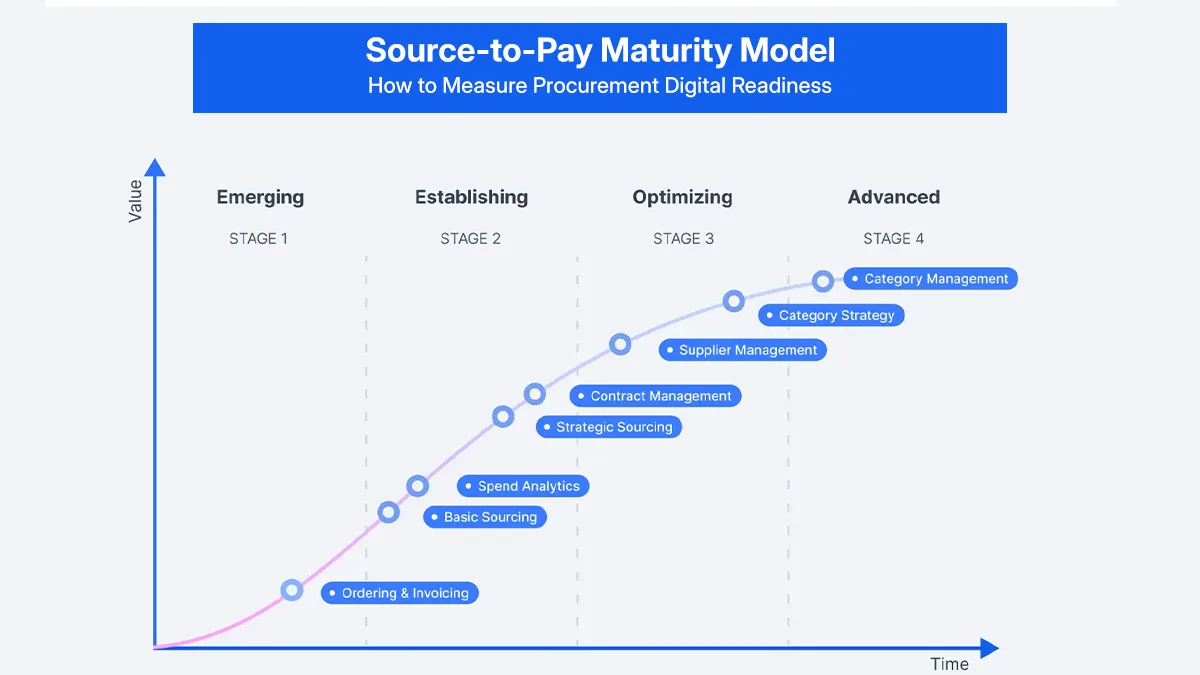
Stages of S2P Maturity Model
A source-to-pay maturity model invariably involves various stages that progress from manual, fragmented systems to organised and automated operations. They are as follows:-
1. Initial (Basic)
At the foundational stage, an organization’s procurement capability increasingly relies on manual, fragmented processes, which leads to inconsistent data, limited idea about spending, as well as supplier performance. Since it is reliant on heavy spreadsheets and paper-based processes, there are errors and delays.
2. Intermediate (Developing)
Basic e-procurement tools are introduced at this stage, with certain activities like purchase orders and invoice processing becoming digitalised. This can be deemed as the early stage of digital procurement wherein, although the processes are systematized, there may still be disconnected systems in place. It might also be that the automation process stays limited to certain tasks and not the entire S2P process.
3. Standardized (Integrated)
All the data, including finance, procurement and supplier data, is centralised. “Manual work is reduced via automated invoices and automated approvals, which in turn gives the procurement team a better insight into their spend, driving digital transformation.”
4. Advanced (Fully-integrated)
This is the fully integrated stage whereby S2P platforms are integrated with other business systems, including Enterprise Resource Planning (ERP). Utilizing advanced automation, from autonomous workflow to real-time analytics support, helps manage repetitive tasks. Now data is driving decisions, not manual reporting processes.
5. Optimized (AI-powered, smart sourcing)
Here the S2P stage is fully automated with AI, predictive analytics and intelligent automation to power decision making. Here, with the aid of procurement digitization, organizations consistently identify opportunities for savings while addressing processing bottlenecks.
All these stages offer a clear procurement benchmark that can help businesses understand where they stand in the S2P process and where they need to elevate to reach the next stage of digital maturity.
Ways to Measure Procurement Digital Readiness
A well-defined procurement assessment can help businesses analyse how well their S2P process, people, systems and data support digital procurement.
Here is how it can be assessed:-
Process Mapping: It includes mapping every stage of the S2P lifecycle. The documentation invariably involves sourcing and purchasing, from invoicing and payment, to identify gaps and inefficiencies.
Testing: It is the comparison of the existing S2P processes of the organization against the benchmarks and norms of the industry. It helps in knowing the current position of the company.
Feedback from stakeholders: This means collecting relevant information from the stakeholders, procurement teams, buyers and suppliers to identify operational challenges which cannot be identified through systems or processes alone.
Evaluation of Technology: This includes an assessment of the current procurement technology to determine the degree to which it supports the S2P lifecycle. Companies should consider the potential for automation, the integration with systems and the extent to which current technology mitigates the need for manual intervention.
Performance Measures: Relevant procurement KPIs are measured herein, such as procurement cycle time, invoice processing, error rates and cost effectiveness. This can help understand whether digital capabilities are delivering the desired results.
These areas collectively provide practical benchmarks that can help businesses to identify their gaps and take the next steps on their procurement digitization journeys.
Common Signs Your S2P Function Isn’t Digitally Mature Everyday operational challenges reveal the lack of digital procurement maturity. If your S2P function exhibits any one of the signs below, your digital capabilities may not be fully integrated.
Manual data entry and heavy reliance on spreadsheets
Requirement of manual fixes for high rates of invoice exceptions
Less clarity into procurement and supplier data
Reliance on physical signatures and long email threads for workflow approvals
Problems in tracking supplier performance
Absence of real-time data and procurement strategy that makes budget tracking difficult
Even if one of these signs exists, it means the business’s S2P function still has gaps, which can become a roadblock to achieving procurement excellence. However, not every gap means an organization need to have a new S2P solution or advanced technology.
For smaller organizations, it may not be cost or operationally effective to invest in a fully integrated S2P platform. In such cases, you need to optimize the existing workflow, integrate the existing systems or automate some activities.
How to Move to the Next Level of S2P Maturity
Moving to the next level of the procurement roadmap leading to S2P maturity requires not just adding new tools, but addressing process gaps, shifting from manual-based work to unified workflows, and aligning technology investments with defined procurement outcomes.
Here is what businesses can do:-
Eliminate fragmented processes: Connect your business’s sourcing maturity, purchasing, invoicing and payment workflows so that they are not isolated processes. This will help create a consistent end-to-end S2P experience.
Automation: Focus on repeatable tasks like order creation, approvals, supplier onboarding etc. The goal is to minimize manual intervention as much as possible, freeing up the team to focus on higher-value work. For example, a mid-sized manufacturing company that processes thousands of supplier invoices manually can utilise automated three-way matching to reduce invoice exceptions. It will also speed up payment processing.
Upgrade your technology: Replace outdated systems with efficient procurement technology that can seamlessly integrate sourcing, purchasing, supplier management, and ERP systems. Businesses can use e-procurement platforms, supplier portals, and e-invoicing to streamline the S2P process.
Use procurement data for informed decision-making: Utilize the real-time procurement data to not just understand what happened but also to identify why it happened and what should be done next. This will help support your business’s supplier decisions, demand planning, risk management and savings opportunities.
Conclusion
The source-to-pay maturity process is not about a technology upgrade in a single action; instead, companies need to conduct an assessment that will help in identifying existing gaps and prioritise required changes.
At last, it is vital to standardize crucial operations, automate repetitive actions and monitor results in order to make certain that every step of S2P improvement leads to successful procurement transformation.
Businesses should therefore first identify the areas that causes delays, errors or manual work and set measurable targets for improvements. They should also implement changes in phases. When results are benchmarked against these phases, organizations can then move to the next priority and progress toward a more digitally mature S2P function.
Need help identifying the right next step for your S2P function? Procure Suite can help you assess your organization’s current processes and build a seamless procurement workflow!