Overview
The sourcing event will provide your team with many vendor responses, pricing information, authorization details, contracts, and follow-ups before any buying activity takes place. All of this information becomes scattered throughout spreadsheets, emails, ERP databases, and procurement software, meaning your team has to spend time aligning information that was already supposed to be aligned. The use of Artificial Intelligence in Procurement becomes much more practical if it operates on the basis of the connected information helping your team manage vendor responses, plan RFx events, analyze spending data, and manage actions in the controlled source-to-pay process.
Procure Suite believes that the AI is a tool that helps perform certain procurement activities but not something that replaces the process itself. The connected source-to-pay process includes sourcing, supplier management, contracts, requests, authorizations, spending analysis, and payments.
Why Prioritize Source to Pay Process Automation?
AI works better when the workflow associated with it is connected. The Source-to-Pay process involves source of suppliers, selection of suppliers, RFQs/RFPs, contracts, requisitioning, ordering, invoicing, and payment. If those activities are done independently, your team can face unclear sourcing processes, spreadsheet errors, fragmented spend data, and redundant manual activities.
The Source-to-Pay Process Automation is a good basis for AI in Procurement. The multi-level approvals, sourcing template reuse, scheduling of the sourcing events, contract life cycle management, spend analysis, and the integration with ERP will help to minimize the repetitive tasks while staying inside the processes.
For your team, the useful question is not simply, “Where can AI be added?” Instead, consider which connected workflow creates the most manual work and needs better information.
AI Is Making Sourcing More Intelligent
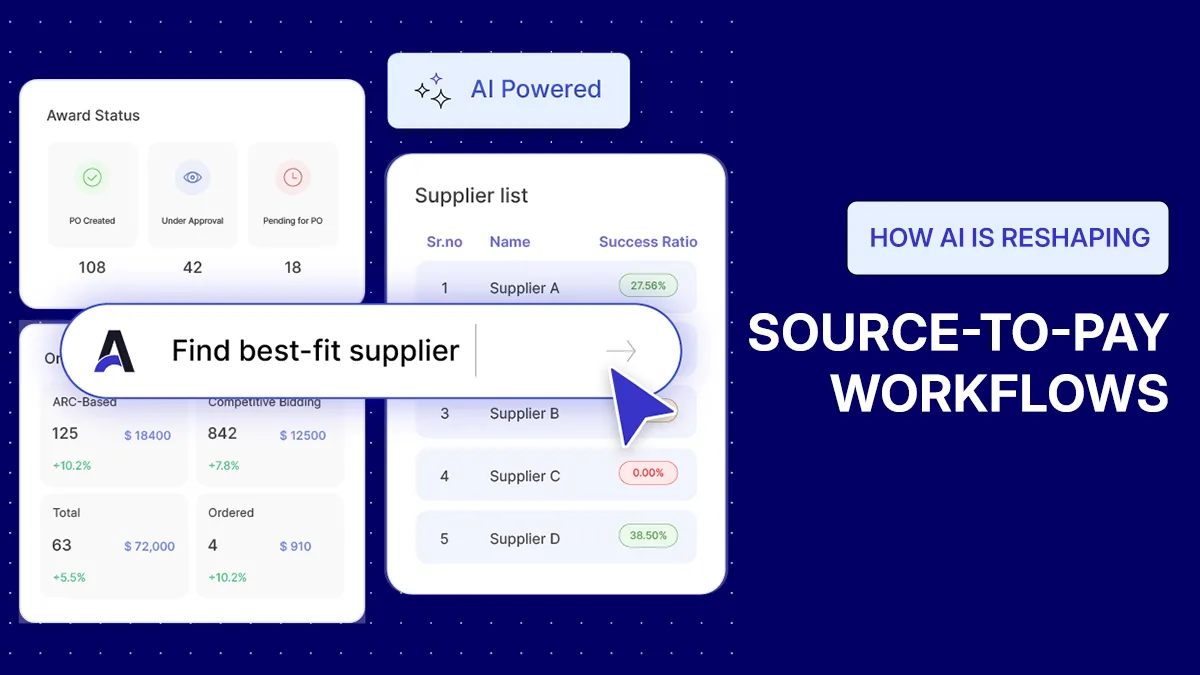
Sourcing is one of the clearest areas for AI support. The ability to assist in creating sourcing documentation and supplier matching and analysis will help you speed up the process of creating sourcing documentation while the ability to organize the information on a multitude of suppliers will help your team evaluate large amounts of data.
The ability to negotiate and follow-up on negotiations will assist in organizing your sourcing event. These capabilities come in handy when your team deals with multiple suppliers or complex RFx responses and instead of comparing all of them manually, your team will be able to notice differences in prices and other terms of offer.
Agentic AI can extend this support by carrying out defined procurement tasks across a workflow. For instance, the AI-driven assistant could assist in preparing the RFx document, gathering supplier submissions, identifying any gaps, or initiating a follow up action. The human evaluation must be maintained for such processes like selecting suppliers, conducting risk assessments, ensuring compliance, and making other critical business decisions.
Workflow Orchestration Integrates Procurement Process Stages
In the case of AI capabilities, more meaningful value can be created when each capability works within a larger procurement workflow instead of being an isolated application. Workflow orchestration can take sourcing, bidding, approval, contracting, spend management, and payment activities to specific stages.
A supplier quote can move from an RFQ into an eAuction bid. Sourcing events can be scheduled in advance, while multi-level workflows can route approvals through the required people. Contract information can be managed from creation and approval through renewal and payment. Real-time spend analytics can then help your team identify purchasing patterns, supplier concentration, and areas that may require further sourcing analysis.
Connecting these activities means an RFx response does not have to become another disconnected record. Supplier information, approval decisions, contract terms, and purchasing activity can remain associated with the broader procurement process, giving AI-supported analysis better context.
Supplier Intelligence Supports Better Decisions
Supplier management becomes easier when crucial data is centralized. Supplier data, onboarding information, performance information, compliance information, and contracts can all be managed using a centralized system. The supplier management solution also supports real-time performance monitoring and automated onboarding processes.
By having centralized supplier records, the AI-assisted supplier analysis will have a better data source. You can analyze your onboarding process, supplier performance, contracts, and other important documents prior to choosing, negotiating with, or managing the supplier.
One specific recommendation is to clean up the data from suppliers and spend before using the AI too heavily. The data that is cleaned up and structured will be a good starting point for supplier matching, proposals analysis, and other procurement activities done with AI.
Spend Automation Makes Purchasing Data Easier to Use
Source-to-pay teams need to know more than what was purchased. It is important that you know where the money is going, who gets the payment, whether there is duplicated or fragmented spending, and where the sourcing opportunities lie.
A spend analysis tool can collect procurement data from multiple locations, cleanse and classify it, identify any duplications in the spending, classify the supplier spending, and provide insights via analytic dashboards. The ability to collect procurement data automatically will reduce manual classification efforts.
In cases where the spend analysis integrates with sourcing, supplier management, contracts, and approvals, your team will have the procurement decisions evaluated in more detail. For instance, if the category involves fragmented purchasing from several suppliers, then you may consider combining suppliers, starting a new sourcing initiative, or analyzing your contracts.
AI-Assisted Workflow in Action
A medium-sized manufacturing firm that sources its components from 25 qualified vendors in different production lines would be able to save time on creating each RFQ as it uses a pre-defined template to schedule an Rfx and sends it to the vendors that match the requirements of the sourcing event. The process of analyzing proposals may be assisted by AI, while the supplier matching will be helpful in evaluating vendors against event requirements.
Once shortlisted suppliers move forward, RFQ responses can feed into an eAuction where appropriate. Approval workflows route the proposed award to the required stakeholders, while supplier and contract records remain connected with the purchasing activity. Spend analytics can show how the proposed award affects category or supplier spend, and ERP integration can pass relevant procurement information into existing resource planning and payment processes.
Value is not in the AI tool making an unrestrained purchase decision. Value lies in your team spending less time preparing, sorting, and transporting the data without giving up control over supplier selection, approval process, negotiation tactics, and exceptions.
Where Does Human Review Still Matters?
AI can help optimize the procurement process, but automated suggestions and agent-based actions still need controls. Supplier selection, negotiation actions, compliance checks, security checks, and policy exceptions may be costly and may even have legal implications.
Your team needs to understand what data will be utilized by an AI-powered system, what actions it is capable of performing automatically, what approvals are needed, and who is accountable for an exception. Data security, systems integration, data quality, organizational readiness, and potential bias are among the other issues that need to be considered prior to rolling out AI across the procurement process.
It makes sense to delegate routine activities, including RFx creation, organizing of responses from suppliers, analyzing spend data, and regular follow-ups to an AI system, whereas human beings remain accountable for supplier selections, negotiations, policy exceptions, and relationships with suppliers.
Are You Ready for AI-Driven Procurement Optimization?
Choose any single procurement process where your team regularly collects, moves, compares, or verifies information manually. Procure Suite will provide assistance to determine how your procurement can be integrated by combining the processes of sourcing, supplier management, workflows, contract management, spend analytics, and ERP integration around the identified process.
Arrange a Procure Suite demo to analyze your process and determine how your team can automate it while not stripping it of controls it requires. You can also reach us via sales@procuresuite.io or dial +91 70460 73434 from India and +1 774 435 1060 from the USA.
Make AI Practical Across the Procurement Cycle
AI in Procurement becomes practical when it has a clearly defined job. RFx preparation can reduce document work. Supplier-response analysis can help organize evaluation data. Spend classification can make purchasing information easier to examine. Follow-up messages help move sourcing activities along in an automated fashion. None of the above-mentioned skills makes it possible to do away with good data, integration, security measures, and accountability.
Procure Suite integrates sourcing, supplier management, procurement, contracts, spend analysis, approvals, and payments throughout the procurement process.
The practical starting point is therefore not “automate everything with AI.” This means selecting a single workflow process that requires considerable effort, identifying the controls surrounding the process, integrating the relevant procurement information, and using the AI technology that addresses the identified problem.