Introduction
A reverse auction promotes strong competition among suppliers. It is, however, fair to say that competitive bidding alone does not guarantee a successful outcome. Supplier participation, category characteristics, market conditions, and auction pattern also impact the final result of the procurement process. It makes it difficult for procurement teams to know whether an auction is likely to deliver significant value in advance.
This is where AI procurement adds value. AI technology aims at identifying patterns that may indicate whether a reverse auction will be successful by analyzing historical data and auction performance. Though AI in procurement cannot guarantee the outcome, it can help your company’s procurement teams make better decisions before and during an auction. It offers procurement analytics and predictive insight to improve auction planning and sourcing.
AI predictions can be highly reliable if they have a backing of high-quality, relevant data. AI in procurement is useful to evaluate auction outcomes more broadly. This blog explores the role of AI in predicting success for your reverse auction process.
How AI Can Predict Reverse Auction Outcomes
AI does not work in a way that requires it to know which supplier will win an auction to give useful predictions. It directly identifies patterns from previous procurement events and estimates the likelihood of different outcomes. A procurement AI system can analyze variables, including previous winning bids, frequency of bids, price movement during auctions, historical participation, etc. This information helps the AI system estimate the success of reverse auctions.
For example, suppose similar categories receive bids from only two suppliers. Historically, comparable categories with four or five qualified suppliers consistently achieve stronger savings. In such a scenario, AI may flag the auction with two suppliers. It is because such an auction has a lower probability of success. It enables procurement teams to change their strategy before launching the auction event.
Data Requirements for Better AI Predictions
AI cannot produce reliable procurement predictions without meaningful data. Here is a list of useful data for better and more accurate predictions-
Historical Auction Data
Results of previous auctions can reveal how suppliers behave in similar sourcing events.
Supplier Data
Supplier participation, response rates, performance, and category expertise are important.
Pricing Data
Bid movements and historical prices can help companies identify potential pricing patterns.
Spend Data
Historical spend analytics can identify categories where competitive sourcing is beneficial. AI can generate more useful procurement intelligence when all these datasets are ready. It has a vast scope in the reverse auction process.
Though AI cannot predict which suppliers will participate in the auction, it certainly helps procurement teams build more effective invitation lists.
Scope of AI in Reverse Auction Process
AI in procurement is useful in multiple ways. It identifies several factors by analyzing historical supplier bidding data. Some of these factors include-
Typical opening bid levels
Average bid reductions
Frequency of counter-bids
Response speed
Final bid behavior
These insights can help buyers understand competitive dynamics in advance. AI also supports auction optimization. Procurement teams can use it to explore how the auction or sourcing event could be structured. Whether it is starting price or auction duration, supplier invitation strategy, or number of bidding rounds, AI can indicate potential areas for optimization.
How Reverse Auction Software Uses AI
A reverse auction platform becomes more useful when it goes beyond supplier bidding management. Modern reverse auction software is useful to get actionable insights before, during, and after the event. It combines auction data with supplier information, historical pricing, category performance, and sourcing results. An AI-enabled platform can transform the reverse auction into a data-driven sourcing activity.
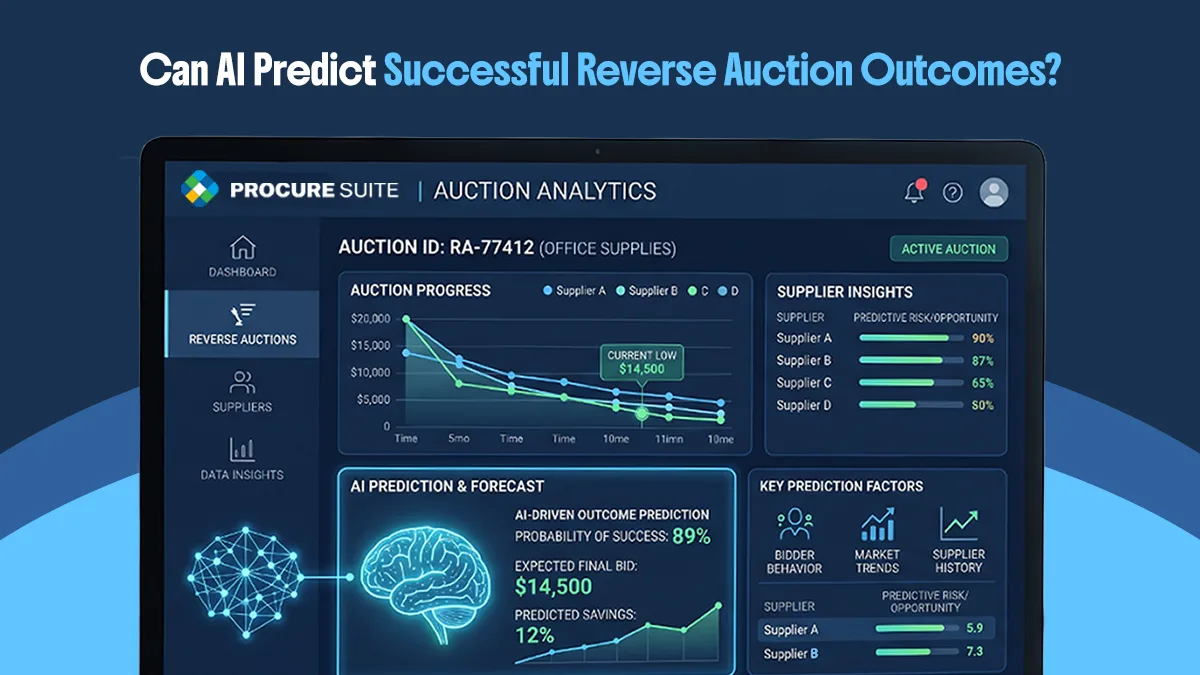
A reverse auction solution is useful to get information about suppliers that are likely to participate, and whether the current level of bidding is competitive. AI technology makes it possible and answers the questions related to the reverse auction event. It predicts potential savings as well. AI-driven reverse auction software can analyze historical data to reveal-
Starting prices
Number of participants
Category
Purchase volume
Bid reductions
Market conditions
This information is useful for estimating a potential savings range for your auction event. AI can also predict the intensity of competition by analyzing previous bidding patterns. It offers sourcing analytics to procurement teams. They can compare auction results by category, supplier, business unit, savings, participation, and duration easily. This data is useful for making strategic sourcing decisions in the future. We can consider it as AI decision-making.
Limitations of AI in Reverse Auctions/Can AI Guarantee Auction Success?
AI supports procurement professionals during and after reverse auctions. It can identify significant price movement, supplier inactivity, unusual bidding patterns, and competition between leading suppliers effectively. AI also works well in combination with procurement automation. It is, however, fair to say that AI is not a substitute for procurement expertise.
As this technology depends largely on data, if historical information is incomplete or inaccurate, AI predictions may be unreliable. Unexpected inflation, supply shortages, and geopolitical events can make historical patterns or predictions less reliable. Suppliers may change their bidding strategies at any time due to several factors. In such a scenario, AI may not be proven helpful for your company. Finally, AI can support decisions, but does not guarantee outcomes.
Key KPIs for AI-Driven Reverse Auctions
Your procurement team should establish KPIS before using AI. These KPIs will help you evaluate auction performance.
Savings Rate
Teams can compare the final winning bid against the approved baseline, previous purchase price, or starting auction price. This depends on the sourcing methodology. It is, however, necessary to use a consistent baseline.
Supplier Participation Rate
If many invited suppliers are participating, it does not necessarily mean strong competition. Your procurement team should monitor the percentage of qualified suppliers that actually participate in the event.
Bid Activity
A high level of meaningful bidding may suggest that suppliers are competing actively. It is, however, fair to say that bid volume alone is not enough to consider that the event was successful.
Supplier Performance
Even if the supplier has mentioned the lowest auction price, if there is a failure in meeting quality or delivery requirements, this price has limited value. Post-award supplier performance is therefore essential.
Let’s go through the impact of combining AI and human expertise in strategic sourcing.
AI & Strategic Sourcing- How to Combine AI with Human Expertise
This technology helps procurement teams prioritize sourcing opportunities based on spend, supplier competition, risks, and category through its integration into strategic sourcing. For example, an organization may have many purchasing categories but limited procurement resources. Here, AI-assisted analysis is useful in identifying categories with significant addressable spend, strong historical competition, standardized requirements, etc.
It is, however, better to keep in mind that AI is not here to replace procurement professionals. Even the most powerful model is a combination of technology and manual decision-making. AI can process large datasets, identify patterns, calculate possibilities, and bring anomalies out. Procurement professionals understand the hidden meaning of these signals. Technology combines with human expertise to strengthen AI decision-making in the procurement process.
How Procure Suite Supports AI-Enabled Reverse Auctions
Procure Suite helps companies run reverse auctions, get supplier information, and perform sourcing activities. As an advanced reverse auction software, Procure Suite assists your procurement team in managing competitive bidding events. It enables your company to follow a structured digital workflow instead of spreadsheets and manual communication.
Procure Suite offers broader information about bid activity, supplier participation, pricing trends, auction outcomes, and category-level spend. This AI-powered procurement management software performs sourcing analytics for allowing your team to make data-driven decisions. It reduces repetitive administrative tasks, supporting the broader procurement automation process.
Concluding Remarks
We will conclude with the same question: can AI predict successful reverse auction outcomes? To answer this question, it can provide a useful probability-based assessment; however, it cannot guarantee success for the reverse auction events. AI in procurement is beneficial for supporting the decision-making process.
When combined with procurement analytics, predictive analytics, sourcing analytics, and procurement forecasting, AI can help companies move to proactive processes. Companies that use reverse auction software should determine auctions that are capable of generating meaningful value. AI can make a huge difference here by offering real-time data.