Introduction
Competitive pricing is one of the most effective ways to reduce costs. An auction process where companies can get lower bids because of increased competition among suppliers can serve the purpose. It is, however, necessary to keep in mind that a lower bid does not mean a lower overall cost.
We talked about a reverse auction where companies can get the advantage of competitive pricing. It is fair to say that reverse auction procurement does not fit every sourcing event. A category with standardized specifications and meaningful price competition is suitable for a reverse auction.
The right approach is, therefore, not to use reverse auctions as a default cost-cutting strategy. When a strategic supplier relationship, market volatility, and quality-focused products are in focus, price may not matter. Your company should evaluate various factors before selecting the sourcing method.
For procurement teams, the practical question therefore should be: When does a reverse auction create competitive value and when can it create unnecessary risk? This post talks about the top situations when you should avoid reverse auctions. Let’s start by answering another important question.
Lowest Bid is Not Always the Lowest Cost
The most important limitation of a reverse auction is that it makes price highly visible while other value-driven elements are difficult to compare. It is essential to check whether a supplier who has submitted the lowest bid does not bring
Longer delivery timelines
Lower quality standards
Weak after-sales support
Higher implementation costs
Poor compliance & performance
If any of these factors create additional costs later, your company’s initial savings may disappear. This is why TCO is necessary to consider before launching a reverse auction event. TCO (Total Cost of Ownership) may include
Purchase Price + Logistics + Implementation + Maintenance + Quality Costs + Switching Costs + Risk-Related Costs
A procurement team that evaluates the event through price may therefore select the wrong way to save costs.
Situations When Procurement Teams Should Avoid Reverse Auctions
Your procurement team should evaluate whether a reverse auction matches the characteristics of the purchase. Here we mention some situations where procurement teams should consider other approaches.
1. For Highly Specialized Service or Product
A reverse auction works best when suppliers can compete on common and comparable requirements. If requirements are highly specialized, including custom engineering, complex consulting, technical integration, or proprietary technology, it is better to consider other options.
A structured RFP, technical evaluation, negotiation, or the combination of these sourcing methods can be appropriate in these situations. It is because suppliers may suggest different technical approaches rather than competing to sell the same product at a lower price.
2. For Purchasing High-Quality Product
Some categories require implementing the right procurement strategy because they carry some quality implications. A manufacturer may have stronger quality controls or stronger service capabilities, but if quality failures result in downtime, the savings in auction become expensive.
Procurement teams should focus on standardized quality. If a supplier fails to meet quality standards, a price-driven reverse auction event may not be the best choice. Issues in quality or performance can lead to warranty claims, customer complaints, and reputational damage.
3. For Strategic Supplier Relationships
Some suppliers play a crucial role in innovation, business continuity, competitive advantage, and product development. These relationships need collaboration rather than price competition. Such strategic suppliers assist procurement teams in
Joint planning
Product innovation
Capacity commitment
Forecast sharing
Continuous improvement
Risk management
A reverse auction can send the wrong signal to long-term suppliers cum growth partners. Strong supplier relationships can create value, but reverse auctions can ruin the organization’s long-term objective of building a collaborative relationship.
4. For a Small Number of Qualified Suppliers
Competition is the first condition for a reverse auction. If only one or two qualified suppliers are participating in the event, it may fail to create competitive pressure. It is also not advisable to invite suppliers that cannot meet technical, quality, or capacity requirements.
When the supplier market is concentrated, it is better to opt for direct negotiation. When it comes to industries that work on proprietary technologies, specialized raw materials, and regulated components, this approach is preferable.
Procurement teams should understand the actual supplier landscape before selecting an auction.
5. For Significant Risk Remaining in Switching
A lower price may appear attractive till we consider switching costs. Changing suppliers requires product testing, system integration, contract changes, logistics changes, regulatory approvals, etc. These activities can consume significant time and resources.
When it comes to a critical category, switching from an established supplier to achieve a small price reduction may not be useful. Procurement decisions should therefore be considered according to the complete business case.
6. For Volatile Market Prices
Volatility in market prices is high in several categories. Some of the factors, including currency fluctuations, energy costs, geopolitical disruption, and supply shortages, affect volatility. In such a scenario, a supplier may bid aggressively to win the event, but later struggle to maintain the agreed conditions.
Alternatively, suppliers may build a risk premium into their bids to cope with the uncertainty about future costs. When market prices are volatile, a negotiated pricing formula or shorter-term sourcing arrangement can be a better option.
7. For Products that Need Extensive Collaboration
Some purchases involve extensive collaboration with suppliers to determine the solution. For example, a company developing a new product may ask suppliers to help identify
Alternative materials
Design changes
Cost engineering opportunities
Packaging improvements
Manufacturing improvements
Suppliers can collaborate with the buyers to build the solution; however, a reverse auction is difficult when it is in the development stage.
These are some of the situations where it is not advisable to use a reverse auction process.
How Auction Risks Affect Outcomes of Procurement
Every sourcing method carries risk. Some of the common auction risks in the event include:
Aggressive Bidding: Suppliers may bid lower than they can sustainably support.
Reduced Participation: Suppliers may avoid events in the future if the process is price-focused.
Quality Trade-Offs: Suppliers may attempt to protect margins by changing materials and service levels.
Relationship Damage: Strategic suppliers may consider repeated price pressure incompatible with long-term collaboration.
Limited Innovation: A price-centric process may discourage suppliers from proposing innovative products.
Bid Misinterpretation: A low bid may not include all the costs or assumptions that matter to the buyer.
These risks, however, do not mean you should avoid reverse auction. It is better to check the situation, business objectives, and procurement requirements before deciding the sourcing strategy.
Role of Procurement Analytics in Choosing the Auction
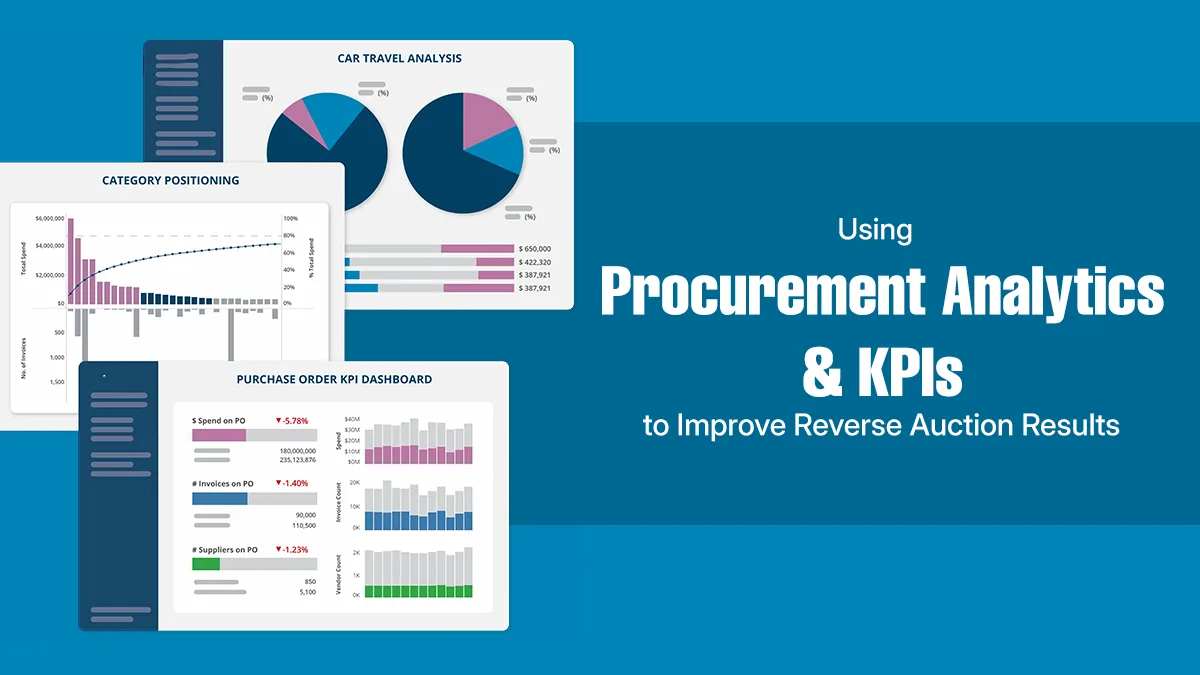
Procurement analytics can help teams evaluate whether a category is suitable for competitive bidding. These analytics include historical purchase prices, spend volume, price variance, supplier performance, contract terms, and market conditions. This data is useful for procurement optimization.
Practical Checklist before Launching Reverse Auction
Here is a useful checklist for procurement teams to decide whether an auction is appropriate-
Standardized specifications
Several qualified suppliers
Objective evaluation of quality
Market stability
Manageable switching costs
Total cost evaluation
Broader sourcing strategy
Accurate information about these aspects can help your procurement team decide the right sourcing approach.
Role of Procure Suite in Smarter Reverse Auction Procurement
Procure Suite offers a centralized procurement environment for managing structured sourcing and competitive bidding. Its built-in reverse auction capabilities can support the digital execution of competitive events.
Procure Suite also offers broader functionality to help your team connect sourcing activities with procurement strategy. As a connected procurement management platform, Procure Suite can improve visibility across supplier information, sourcing activities, and purchasing workflows.
Conclusion
A reverse auction is effective for achieving competitive pricing, improving price visibility, and supporting cost reduction. When products are standardized, supplier competition is strong, and price is a meaningful differentiator, reverse auctions are highly effective.
The strongest procurement teams should, however, evaluate the category before selecting the tool or approach. They consider total cost of ownership, supplier capability, market conditions, and long-term value alongside price. Effective strategic sourcing can save on price and drive growth.