Introduction
Biotech and pharmaceutical companies operate in the most regulated and quality-sensitive sectors. This is a major reason these companies make every sourcing decision carefully. Such decisions can affect product quality, patient safety, and even business continuity. When it comes to the manufacturing process, procurement teams in these companies must manage specialized raw materials and temperature-sensitive products.
Today, procurement professionals have become accountable for ensuring supplier quality, managing supply risks, and improving sourcing efficiencies, with high traceability. It is, therefore, essential to use a cutting-edge procurement solution for Biotech & Pharma. It combines sourcing, supplier management, approvals, and compliance into one process in modern biotech and pharma procurement.
Biotech and pharmaceutical firms have to create resilient supply chains yet avoid delays, improve collaboration, and retain visibility. The proper Source-to-Pay (S2P) approach could be useful to achieve this objective. Whether it is the sourcing of APIs (Active Pharmaceutical Ingredients), laboratory consumables, or cold-storage logistics, companies must make appropriate procurement decisions.
This post aims to analyze the role of efficient S2P platforms in handling biotech procurement, cold chain logistics, and working with specialized suppliers. We will start with a discussion of growing complexity in the pharmaceutical supply chain.
Increasing Complexity of Pharmaceutical Supply Chains
Procurement primarily focuses on cost, supplier performance, and timelines in most industries. When we think of biotech and pharmaceutical companies, procurement teams must ensure regulatory compliance, batch-level traceability, accurate documentation, and continuous supply availability. All these factors contribute to making pharmaceutical supply chains highly complex, with many stakeholders working across different countries and regulatory environments.
Some of these stakeholders include packaging suppliers, regulatory consultants, cold-chain suppliers, quality-testing laboratories, clinical research suppliers, and contract manufacturing organizations (CMOs). Every supplier brings operational, quality, and compliance-related risks. Other macro factors also make pharmaceutical supply chains more complicated.
Importance of Source-to-Pay in Pharma and Biotech Sectors
A proper source-to-pay pharma strategy connects every procurement activity effectively. It covers every step from identifying a sourcing requirement to supplier payment through a standardized workflow. Pharma and biotech organizations gain centralized visibility into supplier onboarding, strategic sourcing, purchase requisition, order processing, and the receiving of goods with Source-to-Pay.
More importantly, Source-to-Pay ensures that all transactions are traceable for conducting audits.
This enables the procurement department to take timely, data-driven decisions while being compliant.
How to Manage Cold-Chain Procurement Effectively
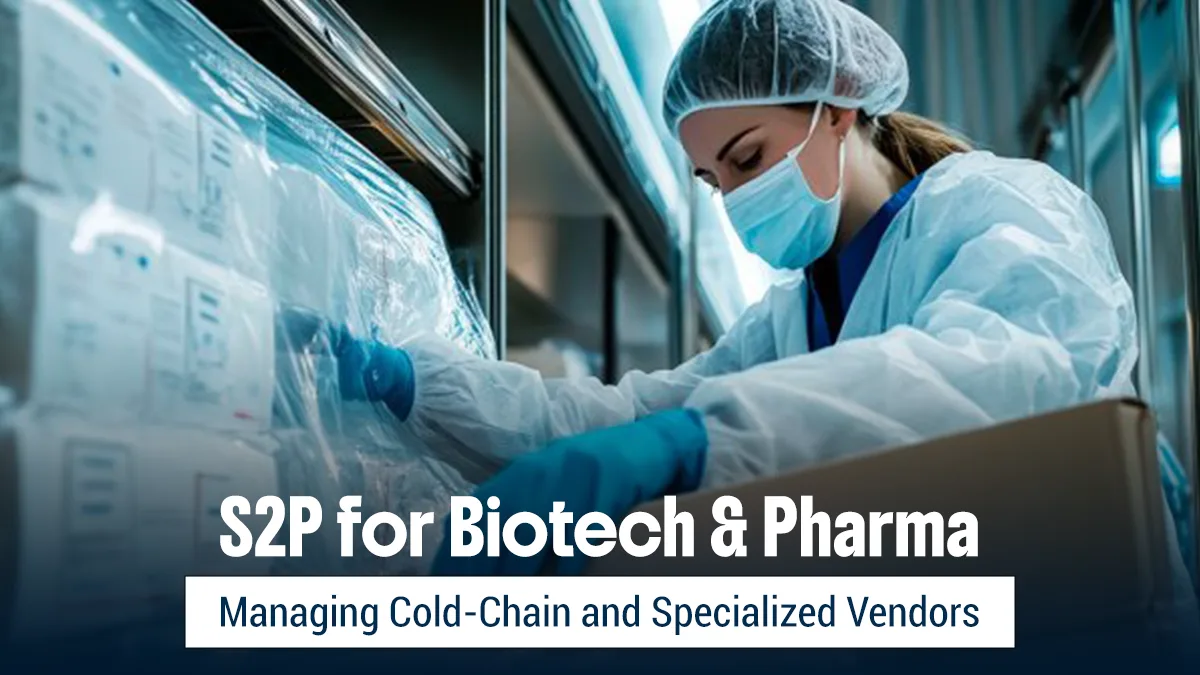
Temperature-controlled products and raw materials are the most difficult parts of biotech procurement. Vaccines, biologics, specialty medicines, diagnostic reagents, and clinical trial samples require strict environmental controls till end. Even a minor deviation in temperature can damage the product. As a result, procurement teams of biotech companies must evaluate logistics providers from the perspectives including
Validated transportation processes
Backup storage facilities
Temperature monitoring capabilities
Geographic coverage
Regulatory certifications
Historical performance
It is fair to say that selecting reliable cold-chain suppliers is essential for managing procurement and product-related risks.
Specialty Suppliers that Biotech Companies Need to Manage
Procurement departments of pharmaceutical and biotech companies should ensure complete procurement traceability. It is necessary for regulatory agencies. Modern S2P platforms create digital audit trails to improve operational efficiency and regulatory compliance. These platforms can assist biotech companies in managing specialty suppliers that provide laboratory reagents, sterile packaging, research chemicals, diagnostic kits, and clinical trial materials.
These suppliers fall under different categories, and they have unique procurement requirements, contractual obligations, and quality expectations. Managing these suppliers through manual spreadsheets can lead to inconsistencies and reduced visibility. A centralized procurement system with S2P capabilities allows biotech companies to have a standardized process and monitor performance within various categories.
Role of Supplier Management in Regulated Procurement
Regulated industries prioritize quality and compliance, and therefore, the supplier management process starts with their selection. An effective supplier management strategy consists of performance monitoring throughout the relationship. KPIs include product quality, compliance, response time, data accuracy, reliability, and corrective measures.
Continuous monitoring of performance by procurement teams helps in identifying risks and working together with suppliers. It can play a significant part in the process of regulated procurement in biotech and pharmaceutical industries.
Workflow Standardization for Regulated Procurement
A manual procurement process may work for small companies; however, highly regulated industries require automated procurement processes for higher accuracy and efficiency.
Procurement automation helps biotech and pharmaceutical companies standardize sourcing activities while reducing administrative effort. It ensures consistency, and companies can standardize processes like purchase requests, supplier qualification and selection, contract approvals, etc.
A powerful source-to-pay software can bring automation in the entire lifecycle. It also takes care of goods receipt verification and payment authorization. As a result, pharmaceutical and biotech companies gain audit readiness. Automation is also beneficial for regulated procurement, which brings both speed and consistency.
Biotech & Pharma Procurement Best Practices
Logistics and procurement are very important in biotech and pharma. An integrated procurement process can help improve healthcare logistics. This process will increase visibility into scheduling, inventory availability, transporters, and receipt of documents. Organizations that apply best practices can leverage the benefits of biotech & pharma procurement.
Some of the useful best practices include
Standardize supplier onboarding process
Supplier auditing and assessment
Increase procurement traceability
Supplier evaluation according to quality, risk, and compliance
Automate processes to minimize manual effort
Continuous monitoring of high-risk suppliers
Your procurement team can create strong sourcing operations with the help of these best practices. These practices ensure continuous compliance with regulations and have the benefit of continuity.
Role of Procure Suite in Biotech and Pharma Industries
Procure Suite addresses specific requirements for biotech and pharma industries. Some advanced features of Procure Suite manage supplier qualification, compliance documentation, cold-chain supplier management, and audit readiness. It offers purchase automation in highly regulated industries.
Procure Suite is a comprehensive source-to-pay platform. Some of its key features are-
Supplier onboarding
Configurable approval workflows
Centralized supplier information
Contract management
Spend analysis
Document automation
Supplier performance monitoring
Procure Suite helps procurement professionals improve governance and efficiency. It brings the benefits of cloud and AI technology to handle regulated procurement more effectively.
Conclusion
Biotech and pharmaceutical organizations need to consider various factors while managing procurement. Their procurement teams need to consider quality, compliance, performance, and resilience issues along with complicated regulations. A structured source-to-pay strategy can standardize operations for high traceability.
Procurement automation decreases manual efforts and improves decisions. A modern procurement solution for biotech & pharma helps these regulated sectors make the process more resilient, compliant, and efficient.