Introduction
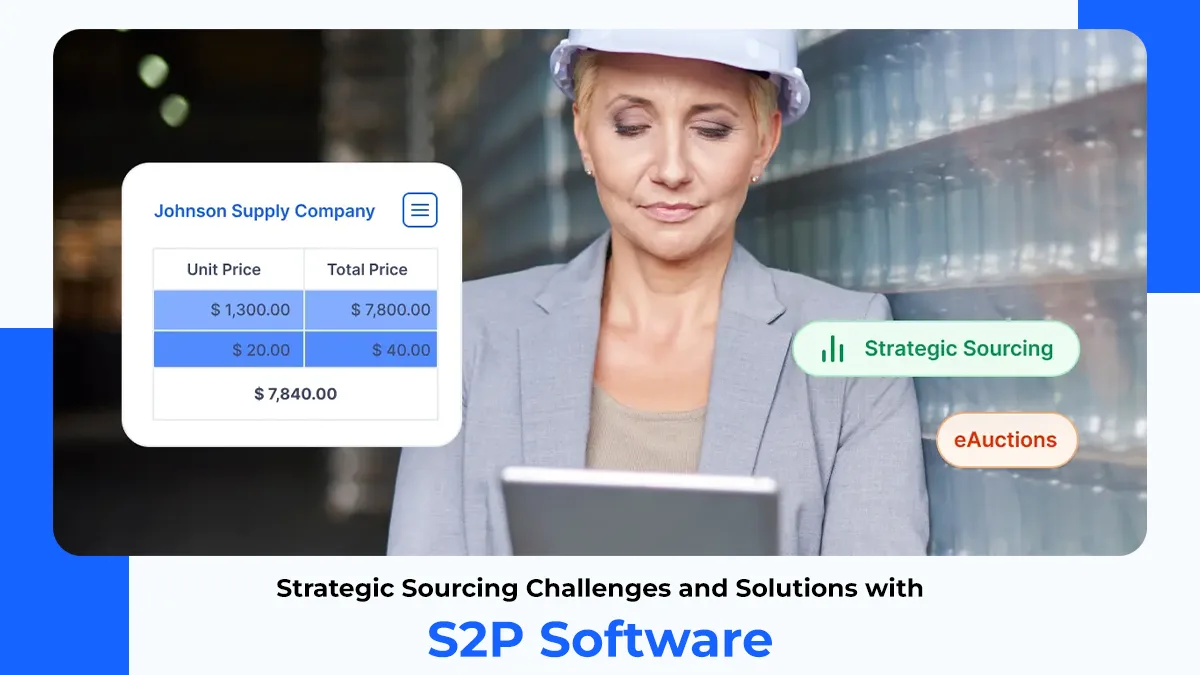
Strategic sourcing plays a significant role in reducing costs and getting better value from the suppliers. Many organizations struggle to actually follow it. Even if a strategic approach seems perfect on paper, teams sometimes fail to execute it.
It generally happens because of everyday operational challenges like a lack of spending visibility, relying on manual processes, and poor communication.
To improve strategic sourcing efficiency, it is necessary to understand the gaps and take a systematic approach to fix them.
This is where source-to-pay software can help businesses. It simplifies the entire sourcing process through task automation, clear visibility, and better control over operations.
In this blog, we will discuss some commonly faced strategic challenges by businesses and how S2P software can help businesses overcome these issues.
Common Strategic Sourcing Challenges and Solutions
Here, we mention some of the most prevalent sourcing challenges that modern businesses face during the procurement process. Also, we will include the ways to overcome these challenges using S2P software.
Challenge 1 - Lack of Spend Visibility
Companies often store their procurement data in scattered tools. These tools are not interconnected. Hence, teams usually face problems while verifying data. Businesses struggle while analyzing spending patterns because all data is stored in various tools. Due to a lack of visibility, they often miss opportunities to save costs in various business operations.
How to Overcome
Companies can implement centralized procurement software that consolidates all data into a single user interface. A source-to-pay platform enables real-time spending pattern visibility through an interactive dashboard and analytics.
This tool enables a category-wise spending view to make data-driven decisions.
Challenge 2 - Inefficient Supplier Management
Supplier management can become complex when companies choose to rely on manual processes. It sometimes leads to improper supplier data, delays in supplier onboarding, and a lack of performance tracking.
How to Overcome
The solution is to implement a structured lifecycle management tool using source-to-pay solutions. These feature-rich platforms help streamline supplier onboarding with properly maintained records. Also, measurable KPIs enable businesses to monitor supplier performance.
With S2P, businesses can see supplier insights and can develop trustworthy supplier relationships. It reduces operational risks and ensures quality delivery.
Challenge 3 - Manual and Time-Consuming Processes
Manual operational processes consume time. They often affect the speed of procurement operations and increase the chances of risks. These inefficiencies directly impact procurement cycles and overall productivity. As a result, businesses might face confusion when making important decisions.
How to Overcome
S2P software can help you automate end-to-end workflows. It allows smooth and interconnected procurement operations. This automation can eliminate repetitive tasks with process consistency. These benefits help speed up approvals and save teammates' time.
Overall, S2P software helps reduce sourcing time. Your procurement teams can focus on other important aspects with streamlined workflows.
Challenge 4 - Compliance and Risk Management Issues
Businesses must maintain compliance with internal policies and regulations while doing strategic sourcing. Lack of proper control can pose risks such as contract deviations, fraud, and regulatory penalties.
How to Overcome
Reliable source to pay software solutions helps an organization practice standardized processes. Organizations can maintain audit trails and ensure policy compliance at every stage. It includes risk monitoring tools for identifying supplier-related risks proactively. When risks are detected in the early stage, teams can get enough time to implement the necessary steps to prevent major issues.
It ensures secure, compliant, and aligned sourcing activities that support business requirements.
Challenge 5 - Poor Cross-Functional Collaboration
Strategic sourcing in the procurement process involves multiple stakeholders. It requires good coordination between teams. Lack of coordination often leads to delays in the process. This can become a major issue when a company relies on clumsy communication tools like emails.
How to Overcome
A centralized source-to-pay platform offers seamless collaboration for teams by providing shared workspaces for procurement, finances, and other departments.
A centralized source-to-pay platform enables seamless collaboration by providing a shared workspace for procurement, finance, and other departments. It ensures every team can have access to real-time data. It allows all stakeholders to stay on the same page throughout the sourcing process.
This improves decision-making speed and ensures better sourcing outcomes.
Challenge 6 - Limited Use of Data and Analytics
Businesses sometimes struggle to use their procurement data effectively because it lacks clear visibility. As a result, teams can face difficulties predicting demand. It also makes supplier performance tracking and decision-making cumbersome.
How to Overcome
Businesses can take advantage of the analytical capabilities of source-to-pay software solutions to manage their procurement process. Smart S2P tools enable powerful insights into a business's spending trends, supplier performance, and market dynamics.
An S2P software allows a business to address all these challenges and makes the most use of procurement data for a strategic approach.
Let’s see real-life scenarios where an S2P can solve strategic sourcing challenges.
Real-World Scenarios Where S2P Solves Strategic Sourcing Challenges
S2P software can solve strategic sourcing challenges irrespective of the industry sectors. Here, we mention some real-life use cases of how S2P brings transformation.
Managing Uncontrolled Maverick Spend in Growing Enterprise
In a fast-growing IT services company, Maverick spending can become common when purchases happen without a structured procedure. It often leads to higher costs and inconsistent vendor contract usage.
An S2P software can enforce strict procurement policies with centralized purchasing in an organization. It gives a business clear visibility into spending patterns. By spending analysis, companies can reduce maverick buying and can gain cost control.
Delayed Supplier Onboarding Impacting Project Timelines
In infrastructure projects, manual supplier onboarding can be time-consuming. It can create unnecessary delays in the procurement process. Sometimes, manual documentation checks and multiple approvals can take up to weeks. It can impact procurement project timelines.
A source-to-pay platform helps an organization digitalize supplier onboarding, speed up approvals, and ensure supplier availability.
Lack of Contract Compliance in Global Procurement Environment
In multi-regional organizations, it is difficult to ensure consistency among procurement teams in properly following negotiated contract terms. It can lead to inconsistent prices.
Source to Pay Solutions can help businesses standardize contract management. It connects contract management directly with procurement workflows. Hence, it results in improved compliance and maintains pricing consistency with cost control.
Poor Demand Forecasting Leading to Over-Procurement
In consumer goods businesses, accurate demand insights are very important to predict raw material order quantity. Lack of demand insights can lead to excess inventory and high holding costs for a business.
A feature-rich S2P software enables analytics and forecasting tools to align procurement with actual demand. It reduces resource waste and improves inventory management.
Conclusion
Strategic sourcing challenges in procurement slow down the process and affect overall business performance. Common operational issues like poor visibility and weak supplier collaboration can make it harder to achieve excellent sourcing results.
A robust source-to-pay software enables an organization to address all these challenges in a structured way. It aligns automation, performance insights, and centralized control to help procurement teams work more effectively. Furthermore, these impactful tools help enterprises make the most accurate decisions to drive business growth.
Businesses adopting modern source-to-pay solutions witness improved efficiency, fewer risks, and stronger supplier relationships.